What if the world you see - the solid chair you're sitting on, the light from your screen, the very fabric of space and time - only behaves this way because you are looking at it? What if, when unobserved, reality dissolves into a ghostly sea of pure possibility? This isn't a thought experiment from a science fiction novel; it's the bizarre and profound implication of one of the most famous and unsettling experiments in the history of science: the double-slit experiment.
This single experiment cracked reality wide open, revealing a quantum world that defies all common sense. It introduced us to the Observer Effect, a concept so strange it has led physicists and philosophers to question the very foundation of what we call real. Prepare to have your understanding of the universe fundamentally challenged.
A Simple Question That Broke Physics: What is the Double-Slit Experiment?
To understand the quantum weirdness, we first need to look at how the world should work according to our everyday intuition. The original double-slit experiment, first performed by Thomas Young in the early 1800s to study the nature of light, can be understood with two simple, real-world examples: firing marbles and making water waves.
Act 1: The Predictable World - Firing Marbles and Water Waves
Imagine a wall with two vertical slits in it. Behind this wall is a second, solid backstop wall that will record where things land.
Now, imagine you're firing a stream of marbles through the slits. Some marbles will bounce off the wall, but many will pass through one slit or the other. What pattern would you expect to see on the backstop? You'd find two distinct clumps of marks, each one lined up perfectly with a slit. This is the behavior of particles-solid, discrete objects that follow a single, predictable path.
Next, let's fill the area with water and create waves that travel toward the double-slit wall. As the waves pass through the two slits, each slit acts as a new source, generating its own circular wave. As these two new waves spread out, they interact with each other. Where the crest of one wave meets the crest of another, they reinforce each other, creating a bigger wave. Where a crest meets a trough, they cancel each other out. The result on the backstop is a classic interference pattern: a series of bright and dark bands, with the most intense band in the center. This is the unmistakable signature of waves.
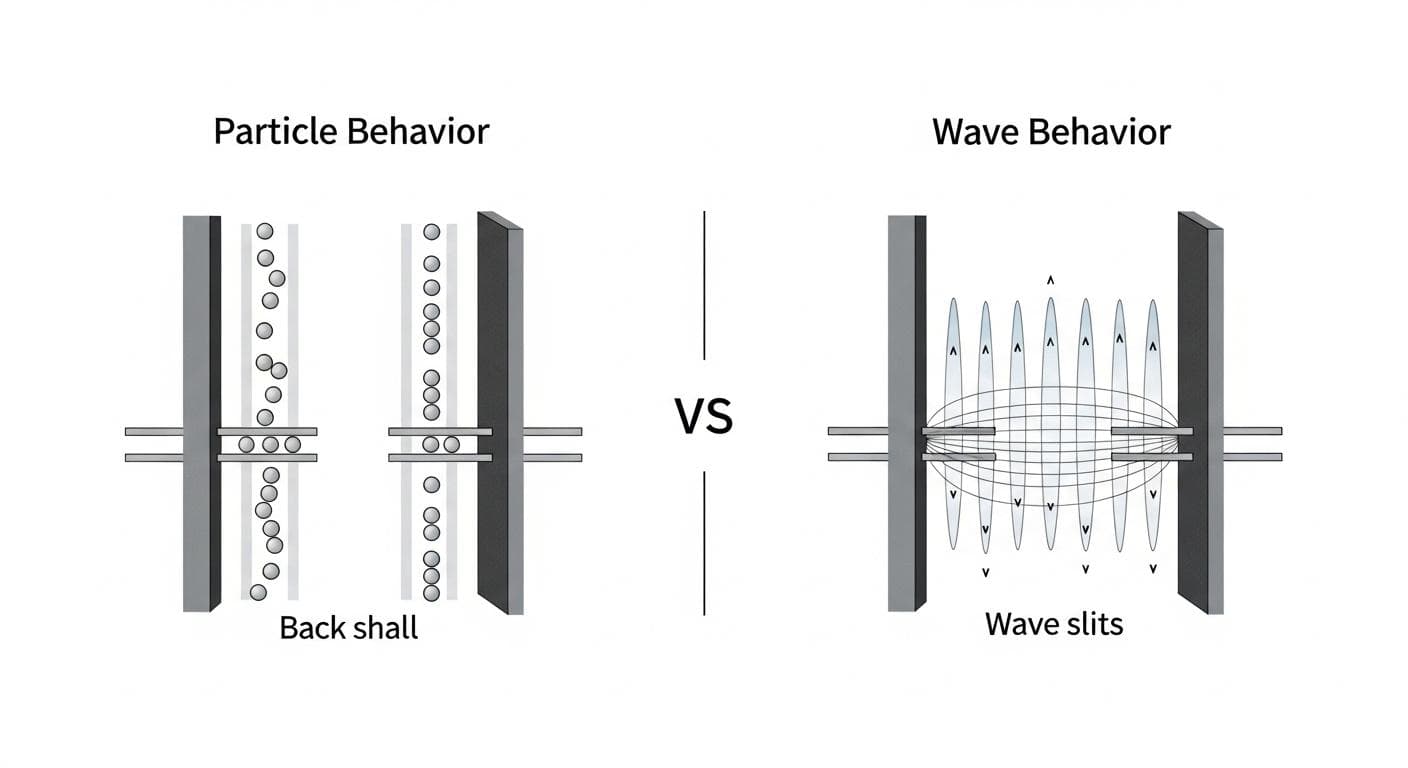
So, the rule is simple: particles make two clumps, and waves make an interference pattern. For a century, this understanding was rock-solid. Then came quantum mechanics.
Act 2: The Quantum Twist - Firing a Single Electron
In the 20th century, scientists decided to repeat this experiment with the fundamental building blocks of our universe: electrons. An electron has mass; it's a definite, tiny bit of matter. It is, by all classical definitions, a particle. If you fire electrons through a single slit, you get exactly what you'd expect: a single clump on the backstop, just like the marbles.
So, naturally, when scientists fired electrons at two slits, they expected to see two distinct clumps. But that's not what they saw. Instead, they saw a wave interference pattern. This result was so shocking it seemed impossible.
The "Spooky" Result: Wave-Particle Duality in Action
This outcome was baffling. How could particles like electrons create a pattern that is the exclusive hallmark of waves? Scientists initially reasoned that perhaps the electrons in the stream were somehow bouncing off each other, creating the wave-like interference. So, they refined the experiment.
The Interference Pattern: How Can One Electron Interfere With Itself?
They modified the equipment to fire only one single electron at a time. An electron would be fired, its impact point recorded on the screen, and only then would the next electron be fired. There was no possibility of electrons interacting with each other. Yet, as the impacts slowly built up on the screen, one by one, the impossible happened again: the interference pattern emerged.
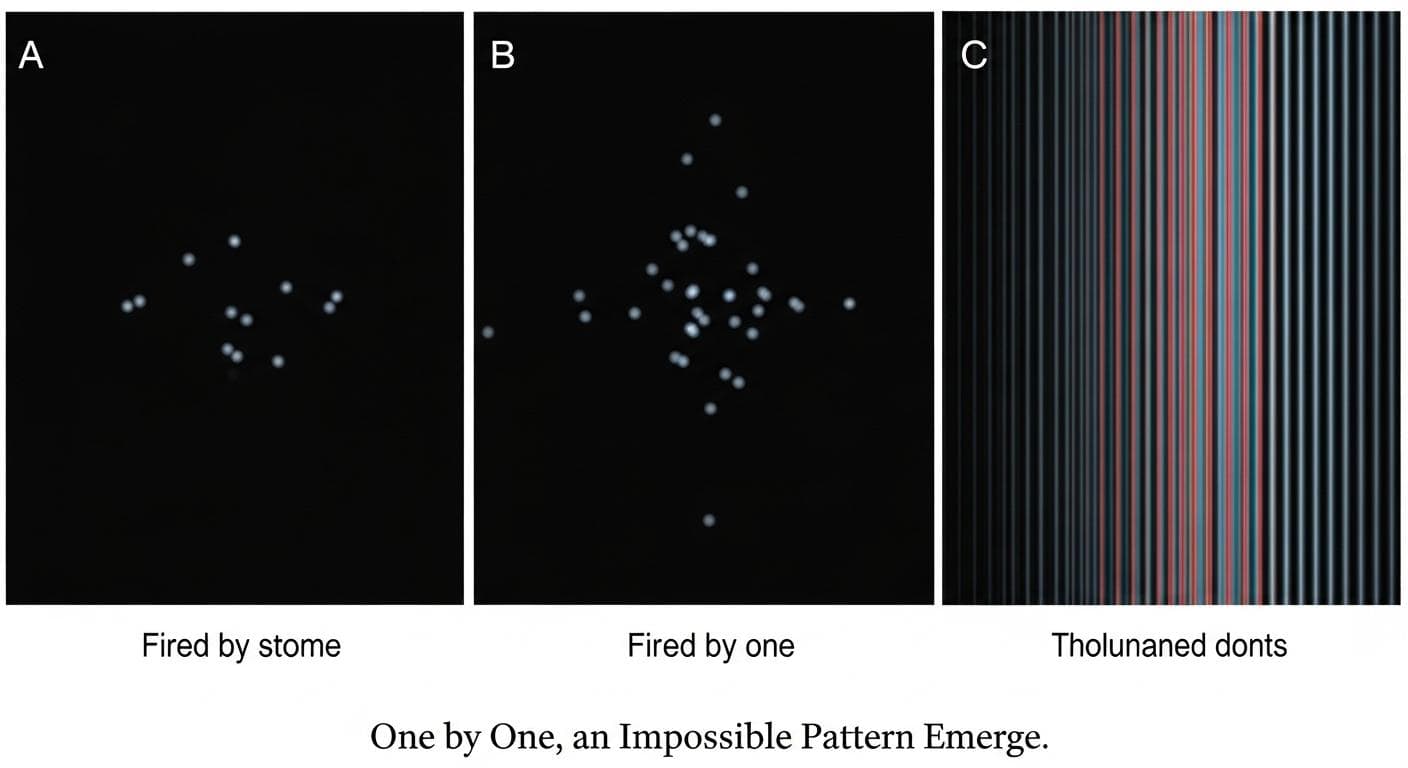
This implies something that shatters our perception of reality. For a single electron to create an interference pattern, it must have somehow interfered with itself. And to interfere with itself, it must have passed through both slits at the same time. The particle, in a sense, behaved like a wave.
Introducing Superposition: The Electron in a State of "All Possibilities"
This is the core concept of quantum superposition. Until it is measured or observed, a quantum particle like an electron doesn't exist in one single place. Instead, it exists in a cloud of probabilities, a smear of potential locations. In the context of the double-slit experiment, the unobserved electron exists in a superposition of states: it goes through the left slit, it goes through the right slit, it goes through both, and it goes through neither-all at once. Its "wave function" describes all these possibilities simultaneously. When it passes through the slits as a wave of probability, it interferes with itself, just like a water wave.
Enter the Observer: When Looking Changes Everything
This result was so deeply weird that physicists couldn't accept it without trying to peek behind the curtain. They wanted to know, definitively, which slit the electron went through. This is where the experiment took a turn from merely strange to profoundly mind-bending.
Adding a "Detector": How Observation Forces a Choice
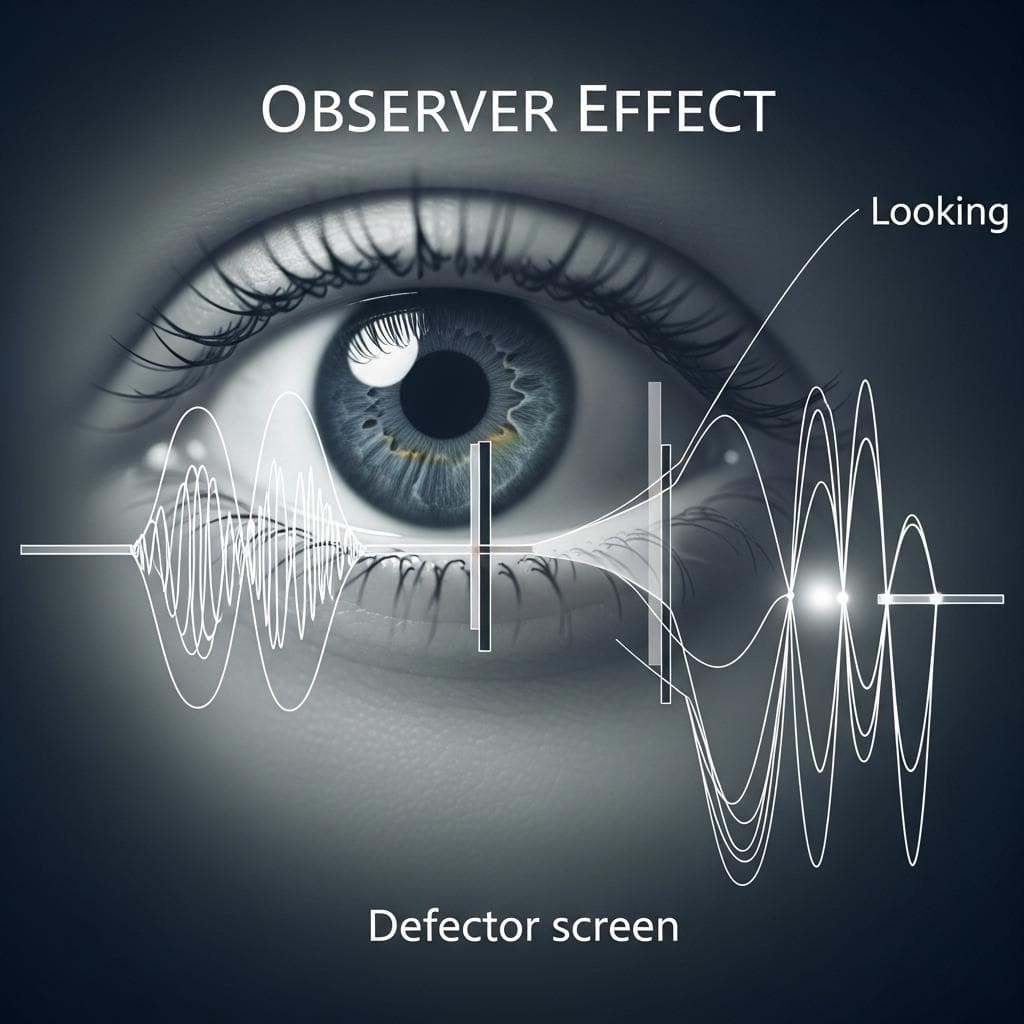
To find out which path each electron took, scientists placed a detector - a sort of microscopic camera - at the slits. This detector would register when an electron passed through, telling them, "This one went through the left slit," or "That one went through the right slit."
They turned on the experiment, firing one electron at a time, but this time with the detectors active. And the moment they did, everything changed.
The interference pattern vanished completely.
With the detectors watching, the electrons behaved like proper, well-behaved marbles, producing two distinct clumps on the backstop. The very act of observing - of measuring which slit the electron went through - forced the particle to "make a choice." The cloud of possibilities collapsed into a single, definite reality. This is the famous Observer Effect.
Does Consciousness Matter? Debunking a Common Myth About the "Observer"
This has led to a popular but misleading idea that a conscious human mind is required to collapse the wave function. The word "observer" is a bit of a misnomer. In quantum physics, an "observation" or "measurement" is any interaction between the quantum system (the electron) and the larger macroscopic environment (the detector) that reveals information about its state.
It doesn't require a human eye or consciousness. The detector itself, by interacting with the electron to determine its position, is the observer. This interaction is what forces the universe to snap out of its state of fuzzy probabilities and commit to a single outcome. The magic isn't in our minds, but in the physical act of measurement.
Pushing the Boundaries: John Wheeler's Delayed-Choice Experiment
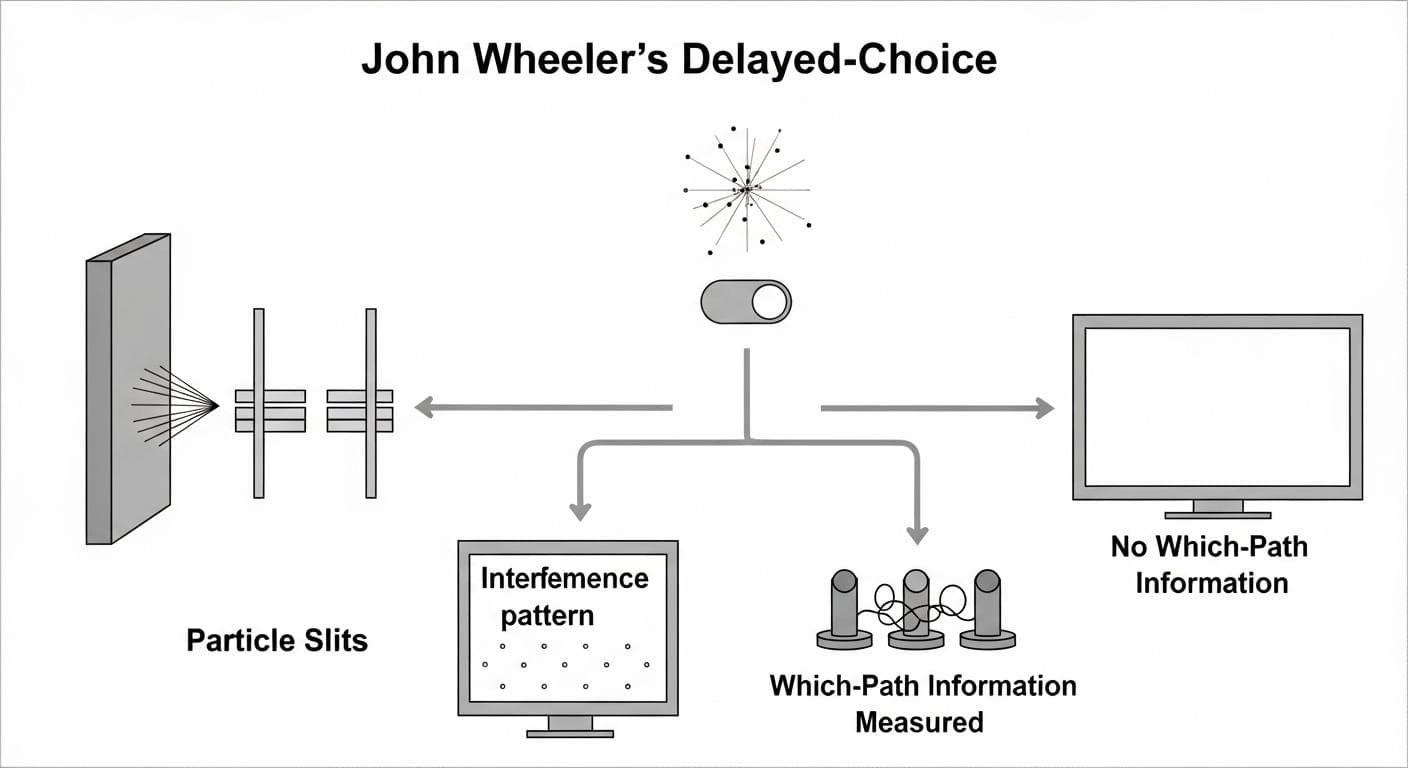
Just when you think things can't get any stranger, physicist John Wheeler entered the scene in the late 1970s with a mind-bending proposal: the "delayed-choice" experiment. He asked: what if we decide whether or not to observe the electron after it has already passed through the slits, but before it hits the backstop screen?
The Ultimate Test: Deciding to Look After the Electron Passes the Slits
In this version of the experiment, the detectors at the slits are removed. A photon is fired. It passes through the slits in its unobserved, wave-like state of superposition. Now, just before it hits the final screen, we make a split-second decision: either we do nothing and let it hit the screen, or we activate a special screen that can determine which path it came from.
Common sense dictates that the photon has already passed the slits. Its past is fixed. The decision we make now shouldn't be able to change what has already happened.
But common sense does not apply here. The results were astounding:
- If the physicists chose not to measure the path, the photon would contribute to an interference pattern, meaning it behaved as if it went through both slits.
- If they chose to measure the path, the photon would register as having come from a single slit, contributing to a clump pattern.
Retrocausality: How a Choice in the Present Can Seemingly Alter the Past
Think about what this means. The choice made in the present moment seemingly reached back in time and altered the history of the photon. Our decision to measure or not determined whether the photon behaved as a particle (going through one slit) or a wave (going through both slits) in the past. This eerie concept is known as retrocausality. It's as if the universe doesn't create a definite history for a particle until that history is observed.
What Does It All Mean? 3 Major Interpretations of the Quantum Mystery
The double-slit experiment and its variations don't just challenge our intuition; they force us to confront the nature of reality itself. Physicists still don't agree on what it all means, but several major interpretations have emerged.
Interpretation 1: The Copenhagen Interpretation (The Standard View)
Developed by pioneers like Niels Bohr and Werner Heisenberg, this is the most widely taught interpretation. It essentially says we should stop trying to visualize what's happening. Physics isn't about describing what reality is, but about predicting the outcomes of measurements. In this view, a particle simply does not have a definite position or path until it is measured. The act of measurement causes the wave function of probabilities to instantly "collapse" into a single, real value. Before that, it's meaningless to ask which slit the electron went through.
Interpretation 2: The Many-Worlds Interpretation (A Universe for Every Outcome)
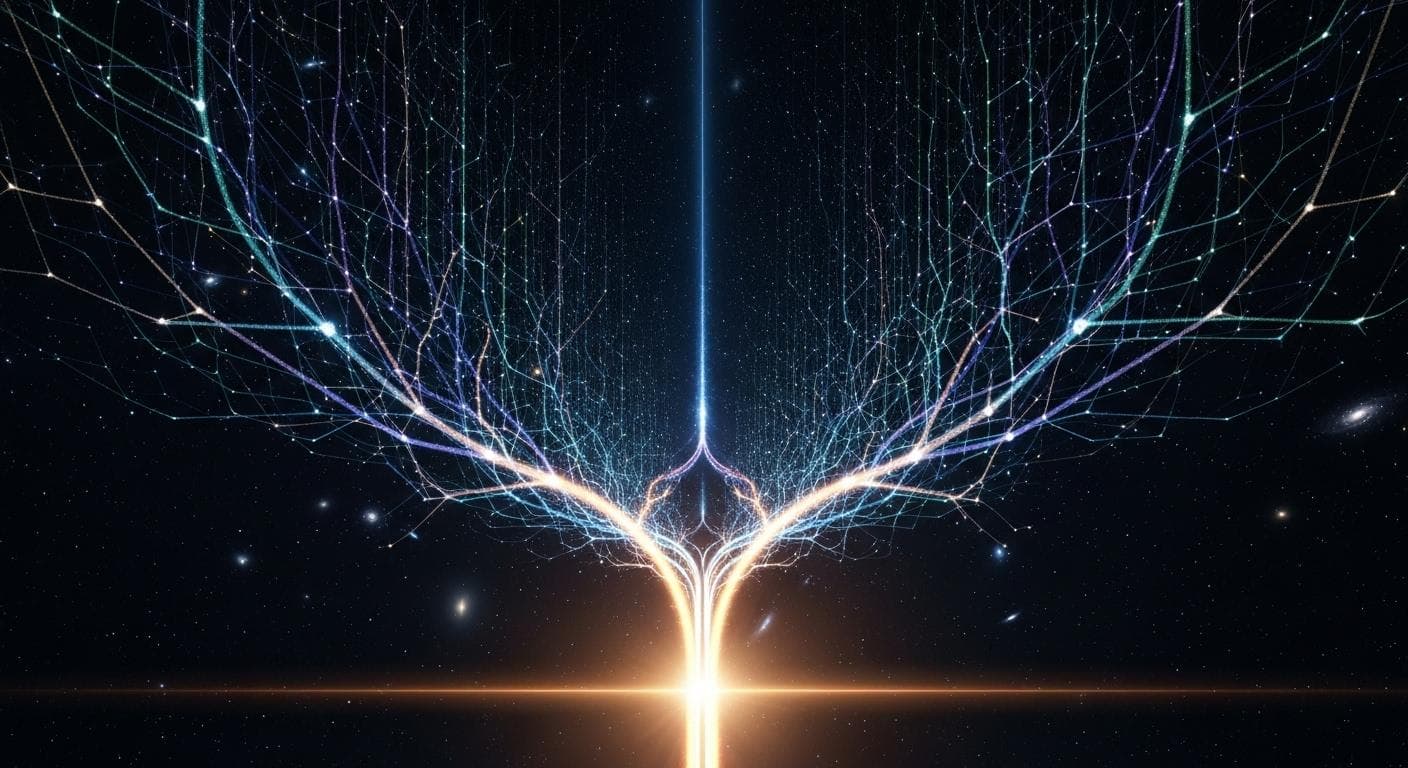
Proposed by Hugh Everett III, this interpretation offers a radical alternative. It claims the wave function never collapses. Instead, every time a quantum measurement is made, the entire universe splits into multiple parallel universes, one for each possible outcome. When you measure the electron, in one universe it went through the left slit, and in another, identical universe, it went through the right slit. This means there is a branching, ever-expanding tree of realities where every quantum possibility is made real somewhere.
Interpretation 3: The Simulation Hypothesis (Is Reality Rendered On-Demand?)
A more speculative but increasingly popular idea is that these results are evidence we are living in a sophisticated computer simulation. In this view, the universe behaves like an advanced video game engine. To save computational resources, the system doesn't render reality in full detail until a conscious observer needs it to. An unobserved electron doesn't need a definite state, so it exists as a simple probability wave. The moment an observer (a player) looks, the system renders a definite outcome, just as a game engine renders a detailed building only when you get close to it. The Observer Effect, in this context, is simply the universe's rendering engine at work. This idea is explored in depth in The Simulation Hypothesis: An In-Depth Guide, which delves into the philosophical and scientific arguments, including Bostrom's Trilemma. The concept of reality being "rendered on-demand" also touches on the immense challenges of simulating an entire universe. Some even suggest that apparent "glitches in the matrix" like the Mandela Effect could be evidence of a rendering system at play.
Conclusion: Embracing the Beautifully Bizarre Nature of Reality
The double-slit experiment serves as a humbling and exhilarating reminder that the universe is far stranger and more mysterious than it appears. It tells us that at the most fundamental level, reality is not a collection of solid, predictable things, but a shimmering dance of potential and probability. The act of observation is not a passive viewing, but an active participation in the creation of reality itself. Whether this points to the standard Copenhagen view, a multiverse of infinite possibilities, or a cosmic simulation, one thing is certain: our common sense is a poor guide to the true nature of existence.
The world is not as it seems. And perhaps the most beautiful part of this quantum mystery is that the questions it raises - about reality, observation, and our place in the cosmos - are even more profound than the answers we currently possess.
What do you think is the most compelling explanation for the results of the double-slit experiment? The standard Copenhagen Interpretation, the radical Many-Worlds theory, or the mind-bending Simulation Hypothesis? Share your thoughts in the comments below!

Comments
We load comments on demand to keep the page fast.