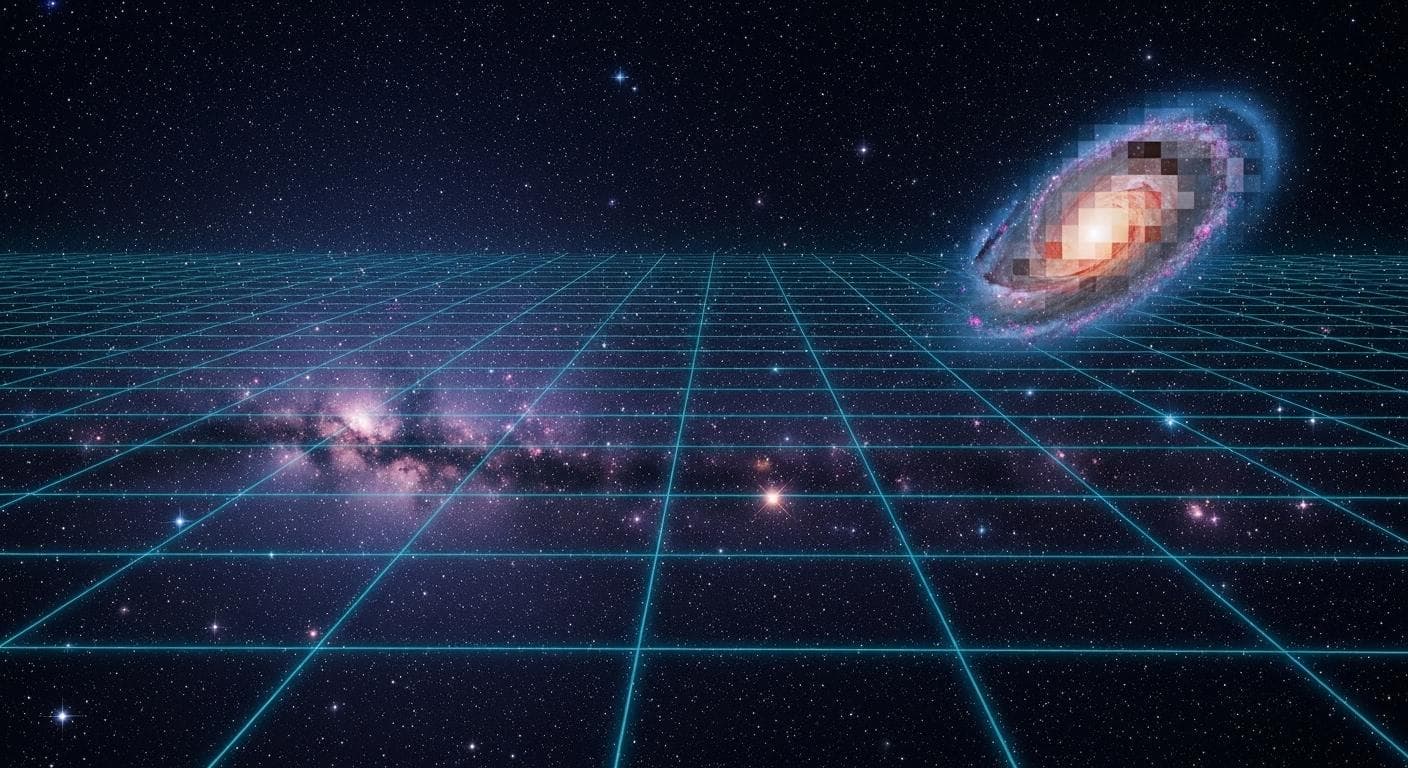
The night sky is a portrait of infinity. With hundreds of billions of galaxies, each containing hundreds of billions of stars, the universe should be teeming with life, a cacophony of civilizations broadcasting their existence across the cosmos. Yet, when we point our telescopes to the heavens, all we hear is silence. This profound and unsettling contradiction is known as the Fermi Paradox, and it poses one of the most fundamental questions of our time: Where is everybody?
For decades, scientists have proposed solutions ranging from the catastrophic to the sociological. But a far more radical and mind-bending explanation is gaining traction, one that suggests the silence isn't an accident-it's a feature. What if the solution to the Fermi Paradox is that we are living inside a simulation, and our cosmic loneliness is by design?
The Great Silence: A Universe That's Too Quiet
What is the Fermi Paradox?
In 1950, over a casual lunch, physicist Enrico Fermi posed a simple question that has haunted science ever since. Given the age and size of the universe, the statistical probability of Earth being the only planet to host intelligent life seems vanishingly small. Any civilization with even a modest head start on humanity and a penchant for exploration should have colonized the galaxy by now. Their probes, signals, or megastructures should be visible. But we see nothing. The paradox is the stark conflict between the high probability of extraterrestrial life and the complete lack of evidence for it.
The Scale of the Problem: Billions of Galaxies, Zero Calls
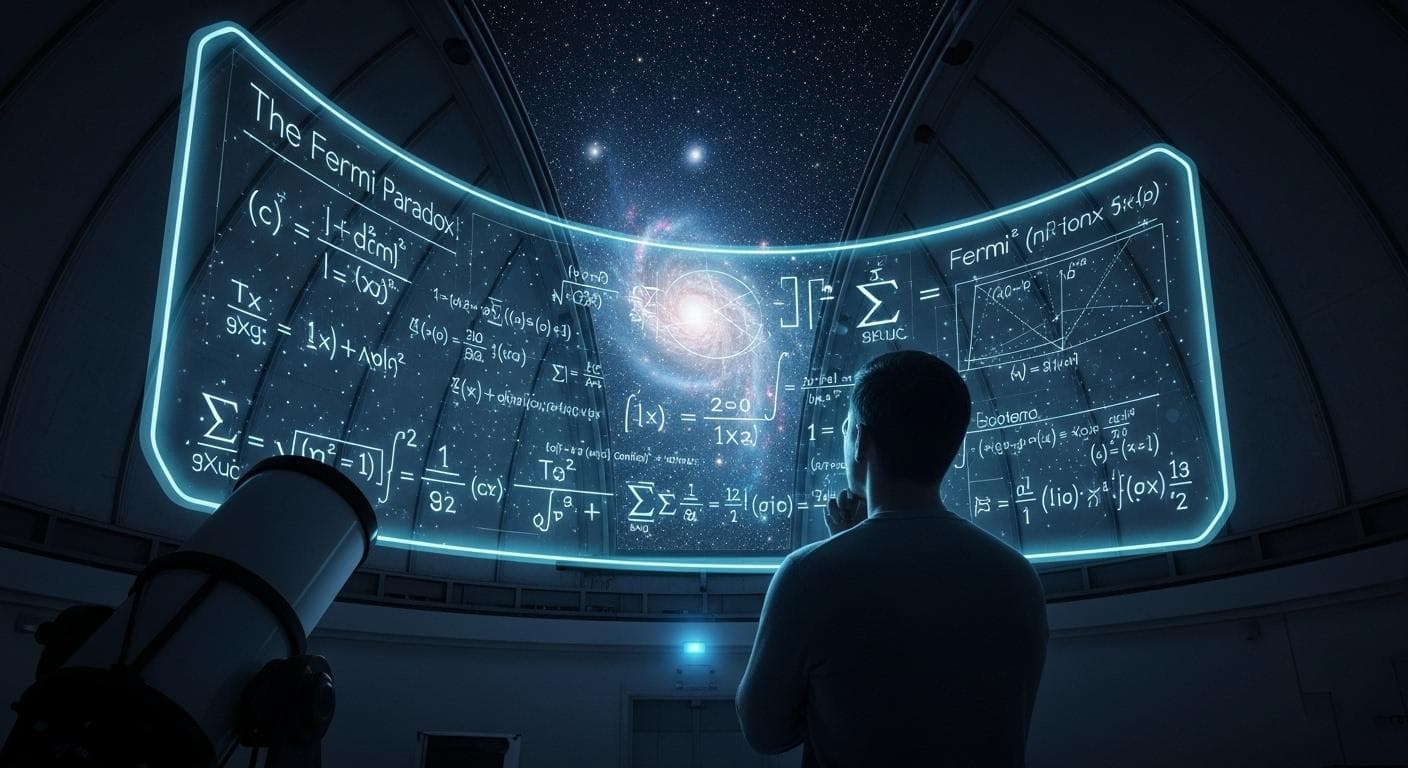
To grasp the magnitude of the paradox, consider the numbers. Our Milky Way galaxy alone is estimated to have up to 400 billion stars. To help think through the probabilities, astronomers use frameworks like the Drake Equation. This isn't a precise calculator, but a probabilistic argument that multiplies several variables-like the rate of star formation, the fraction of those with planets, and the fraction of those that might develop intelligence. Depending on how optimistic or pessimistic one's inputs are, the result can range from us being utterly alone to a galaxy bustling with thousands of civilizations. And yet, despite decades of searching through projects like SETI (Search for Extraterrestrial Intelligence), the cosmic phone lines remain dead.
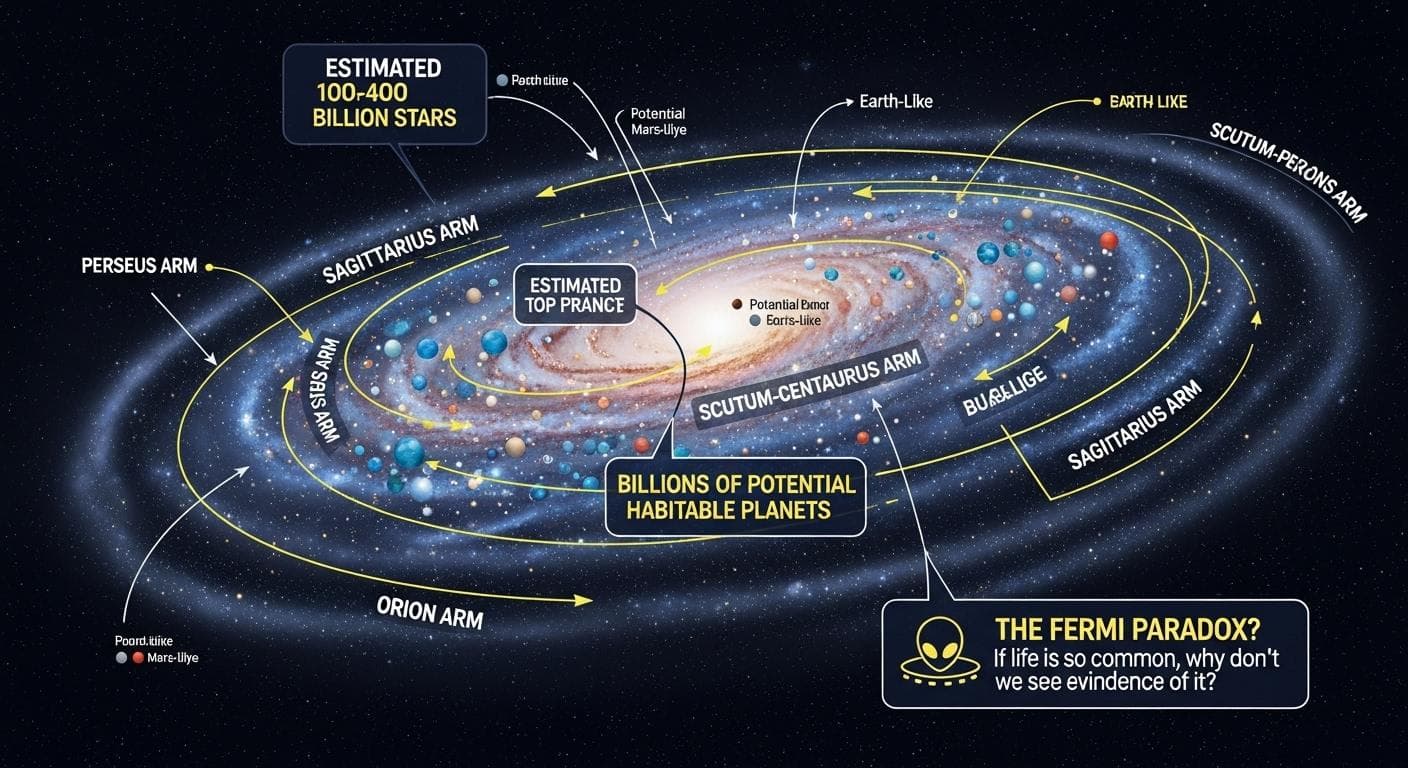
This isn't just a lack of little green men; it's a lack of anything-no signals, no artifacts, no signs of cosmic engineering. It's as if the universe is holding its breath.
A Radical Solution: The Simulation Hypothesis
When conventional answers fail, it's time to consider the unconventional. The Simulation Hypothesis proposes that our entire reality, from the smallest quark to the largest galaxy cluster, is an artificial construct-a computer program of unimaginable complexity.
Nick Bostrom's Trilemma: Are We an Ancestor Simulation?
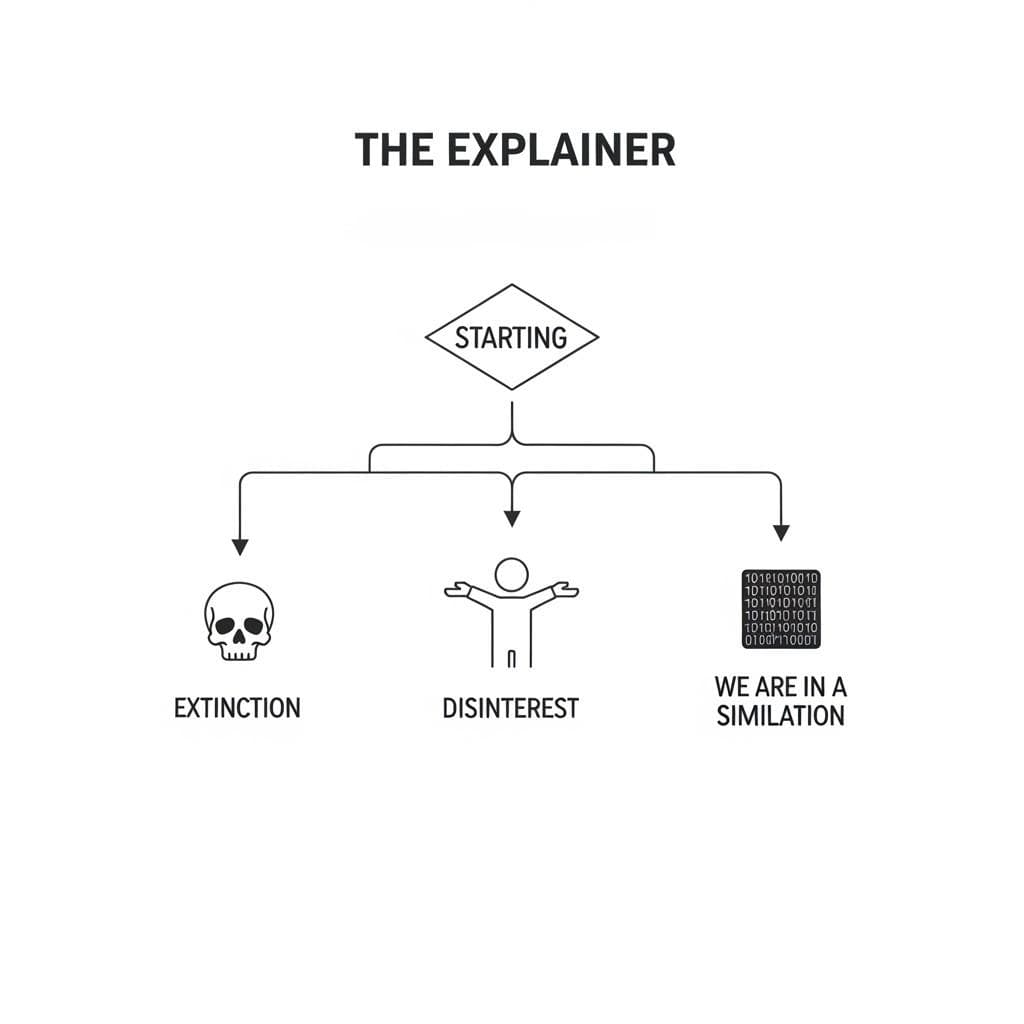
Modern simulation theory was famously articulated by Oxford philosopher Nick Bostrom in 2003. He presented a 'simulation trilemma,' arguing that one of the following three propositions must be true:
- Civilizations almost always go extinct before reaching a technologically mature stage capable of running high-fidelity simulations.
- Mature civilizations are almost universally uninterested in running simulations of their ancestors or similar beings.
- We are almost certainly living in a computer simulation.
The logic is that if civilizations can survive long enough and are interested in running simulations (which, given our own trajectory with video games and scientific modeling, seems likely), they would create not one, but billions of 'ancestor simulations.' In that scenario, the number of simulated realities would vastly outnumber the one 'base' reality, making it statistically almost certain that we are in one of the simulations.
The Core Thesis: What if the Universe is Lonely by Design?
This is where the hypothesis offers a chillingly elegant solution to the Fermi Paradox. If we are in a simulation, the absence of aliens isn't a cosmic mystery; it's a parameter of the program. The creators may have simply chosen not to include other intelligent species. Perhaps the simulation is specifically about humanity, or perhaps rendering additional civilizations was computationally too expensive. Either way, the silence is an intentional, programmed feature, not a bug.
Cosmic Laws as Programmed Features, Not Physical Flukes
If our universe is a program, then its fundamental laws of physics aren't immutable truths-they are the rules of the code, the constraints set by the programmers.
The Ultimate Speed Limit: Is the Speed of Light a Law or a Processing Cap?
One of the most profound constraints on our reality is the speed of light, c. Nothing with mass can reach it, and nothing at all can exceed it. This single rule makes interstellar travel an immense, multi-generational challenge, effectively isolating star systems from one another. From a simulation perspective, this is a brilliant piece of programming. Proponents of the hypothesis argue that a universal speed limit acts as a perfect processing cap, preventing sims from traveling far enough to discover the simulation's boundaries or tax the system's resources by moving too much information too quickly.
"Render Distance": How Quantum Mechanics Saves a Universe's CPU
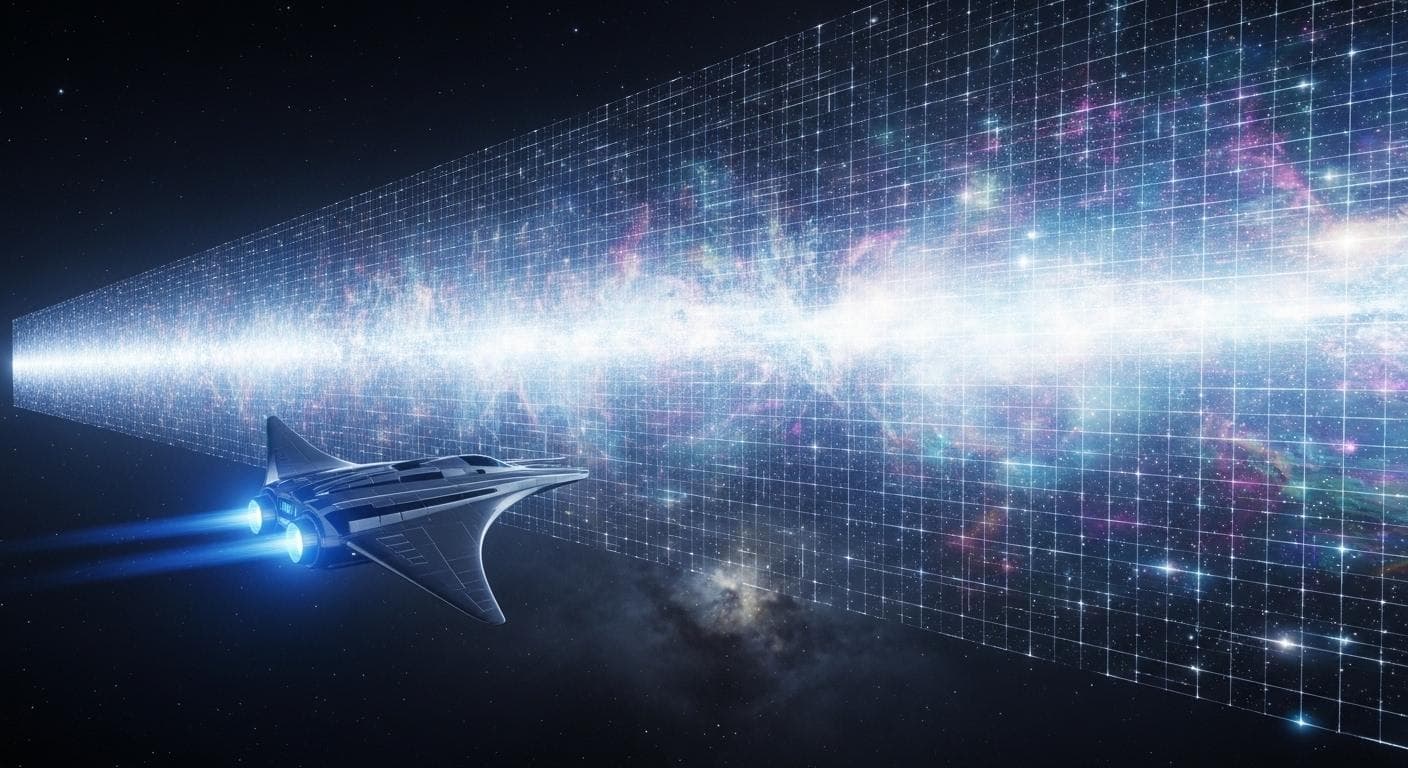
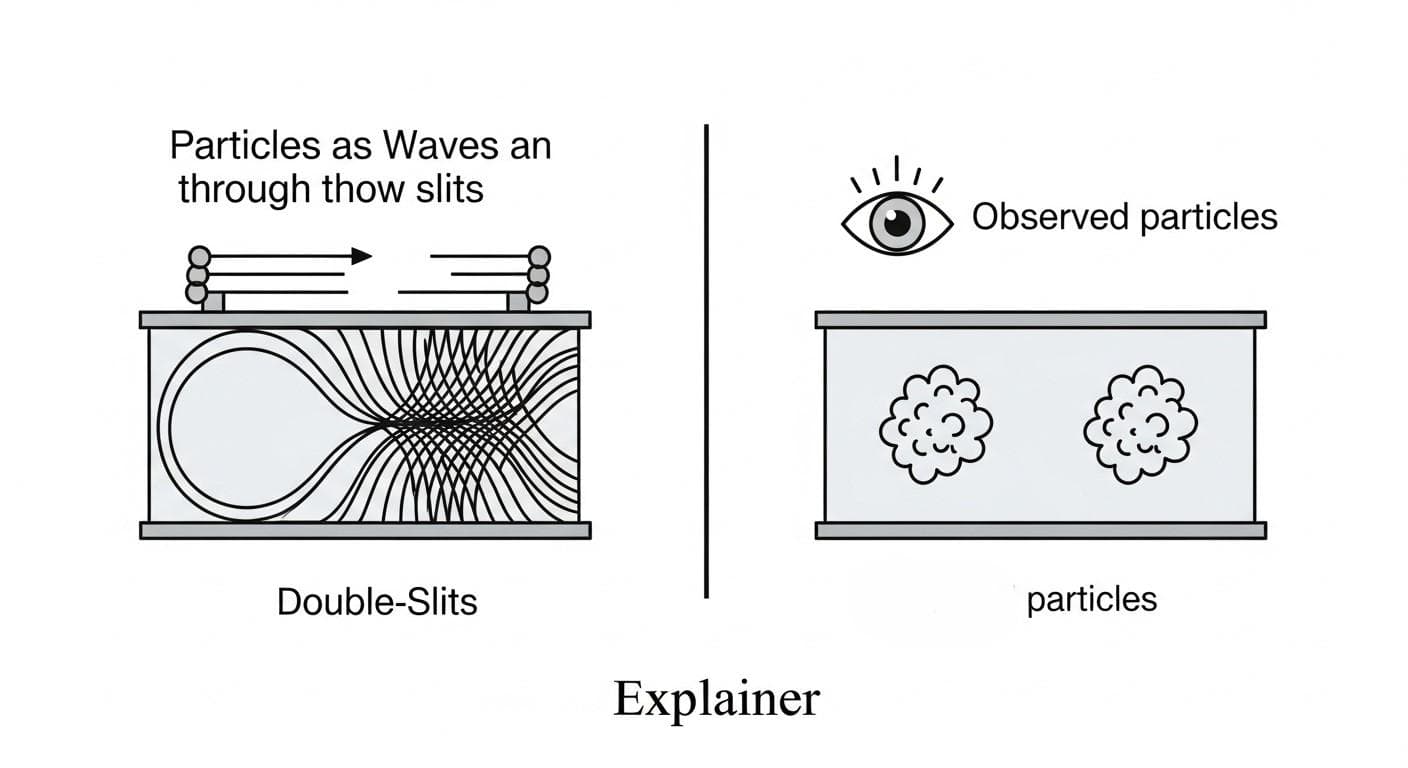
One of the biggest arguments against the simulation hypothesis is the sheer computational power required to simulate every atom in the universe. But as any video game developer knows, you don't render what the player can't see. This concept of resource optimization has a spooky parallel in quantum mechanics: the observer effect, most famously demonstrated by the double-slit experiment.
In this experiment, particles like electrons behave like spread-out waves when not being observed. But the moment a detector is put in place to see which slit the particle goes through, its behavior changes and it acts like a solid particle. Proponents use the analogy of a "render-on-demand" system. It's as if reality doesn't bother rendering a definite state until it is forced to by an observation, drastically reducing the computational load needed to run the universe by only calculating the fine details when a conscious observer looks closely.
Universal Constants: Fine-Tuned for Life, or Hard-Coded for Isolation?
The physical constants of our universe-the strength of gravity, the charge of an electron-are exquisitely fine-tuned to allow for the existence of stars, planets, and life. A slight change in any of them, and the universe would be a sterile void. While some see this as evidence of a multiverse or divine providence, the simulation hypothesis offers another take: these aren't happy accidents. They are variables in the code, deliberately set to the values needed for the simulation to function as intended.
How the Simulation Solution Compares to Other Theories
To appreciate the unique power of the simulation hypothesis, it's useful to compare it to other leading solutions to the Fermi Paradox.
The Great Filter: A Bug, or a Deliberate Feature of the Code?
The Great Filter theory posits that there is some barrier-an evolutionary, technological, or cataclysmic hurdle-that is so difficult to overcome that it prevents almost all life from reaching a galaxy-spanning stage. This filter could be behind us (the leap to complex life was the hard part) or, terrifyingly, ahead of us (e.g., nuclear war, climate change). In the context of a simulation, the Great Filter isn't a natural obstacle. It's a programmed challenge, a hard-coded 'boss level' designed to end the game for most civilizations.
The Dark Forest vs. The Lonely Planetarium: Fear or Engineering?
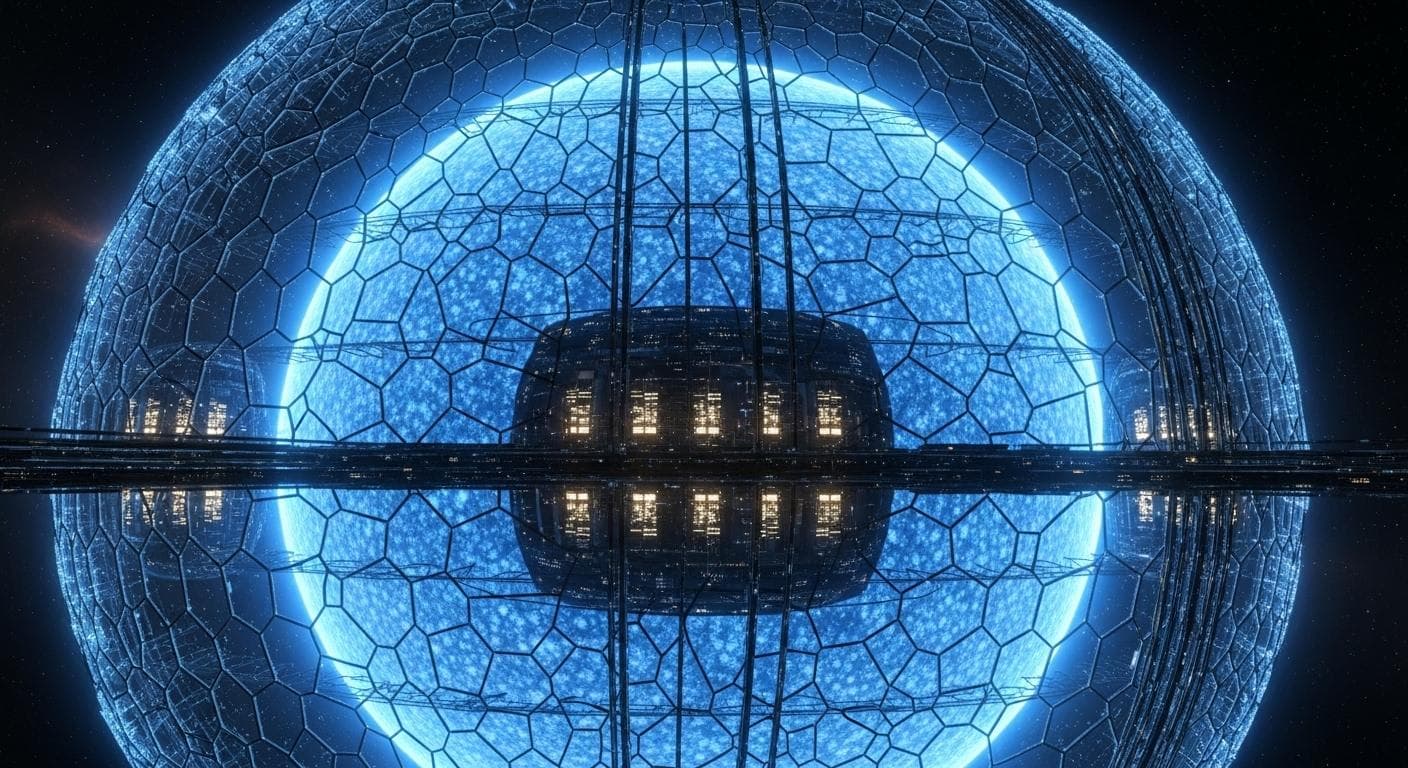
The Dark Forest theory offers a paranoid solution: the universe is full of life, but everyone is silent out of fear. To announce your presence is to invite your own destruction by a more advanced predator. It's a 'shoot first, ask later' cosmos. The Simulation Hypothesis offers a different kind of isolation. It's not a forest full of silent hunters, but a meticulously crafted planetarium designed for a single audience: us. The emptiness isn't menacing; it's just empty.
Why the Simulation Offers a Uniquely Elegant, Albeit Unsettling, Explanation
Unlike other theories, the simulation hypothesis doesn't require us to make assumptions about the sociology, biology, or motivations of countless alien species. It centralizes the explanation into a single, albeit massive, premise. The silence, the fine-tuning of physics, and the weirdness of quantum mechanics all click into place as logical features of an engineered reality.
The Unfalsifiable Problem: Searching for Glitches in the Matrix
Despite its explanatory power, the simulation hypothesis faces a major scientific hurdle: it is incredibly difficult to prove or disprove.
The Scientific Counterarguments: Why This Might All Be Physics, Not Philosophy
Many physicists, like Dr. Michio Kaku, argue that the computational power required to simulate our universe down to the quantum level is a physical impossibility. The only computer powerful enough to simulate the universe is the universe itself. Others point out that if reality were a simulation running on a discrete grid, we should be able to detect evidence of this 'pixelation' at the smallest scales, but so far, spacetime appears smooth and continuous down to the limits of our measurements. The sheer challenges of simulating an entire universe are immense.
Can We Ever Truly Prove We're Sims?
Proving we're in a simulation might require finding a 'glitch in the Matrix'-an undeniable anomaly that violates the established laws of physics. Some have even proposed searching for hidden messages or 'backdoors' left by the programmers in the cosmic microwave background radiation or other physical constants. But for now, the hypothesis remains in the realm of philosophy, a grand thought experiment that challenges the very foundation of what we consider 'real.'
If we are alone in the universe by design, it fundamentally reframes our place in the cosmos. It could mean that our existence, our struggles, our triumphs, are the entire point of the experiment. We are not just one of countless species in a vast, indifferent universe; we are the sole focus of an unfathomable intelligence. Whether that purpose is for scientific research, entertainment, or something beyond our comprehension remains the ultimate question.
Ultimately, the simulation hypothesis provides a strange and profound comfort for the Fermi Paradox. The Great Silence may not be a sign of our cosmic insignificance, but rather, a testament to our singular importance. We are alone because the story is about us. And we are just now beginning to read the code.
What do you think? Is the simulation hypothesis the most compelling solution to the Fermi Paradox, or is it a philosophical dead end? Share your thoughts in the comments below!

Comments
We load comments on demand to keep the page fast.