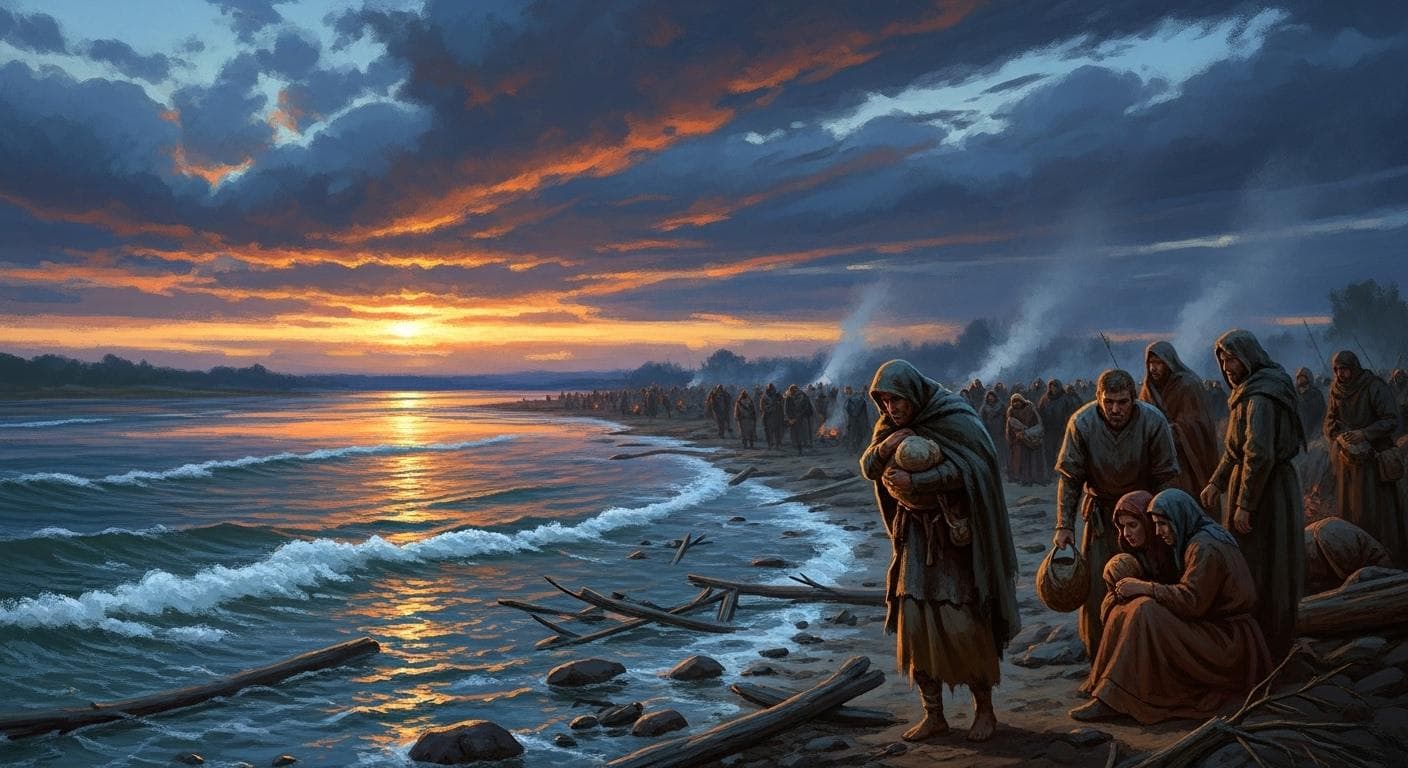
More Than an Invasion, A Test Rome Failed
For centuries, the story of Rome’s fall has been simplified to a tale of “barbarian invasions.” It’s a narrative of savage hordes overwhelming a civilized empire, a sudden and violent end to a golden age. This view is not just simplistic; it’s wrong. The collapse of the Western Roman Empire was not an acute event but a chronic illness. The arrival of the Goths on the banks of the Danube in 376 AD was not the disease itself, but the definitive diagnostic test-a crisis that laid bare the deep, systemic rot that had been festering for generations. To understand the broader context, explore The Ultimate Guide to the Fall of the Roman Empire.
This is a case study in organizational collapse. The Gothic migration crisis was a manageable geopolitical event that, through a cascade of catastrophic mismanagement, corruption, and strategic arrogance, became the catalyst for the empire's unraveling. It proved that Rome was no longer the flexible, resilient superpower of Augustus or Trajan. It had become a brittle, hollowed-out giant, and the Goths were simply the first to prove it could be broken.
The Brittle Superpower: Rome's Hidden Sickness in the 4th Century
By the late fourth century, the Roman Empire looked powerful on a map, but its foundations were critically weak. The infamous “Crisis of the Third Century”-a 50-year period of civil war, plague, and economic collapse-had left deep, lasting scars. You can learn more about this tumultuous period in Rome's Internal Decay: From Commodus's Chaos to the Third Century Crisis. While emperors like Diocletian and Constantine had stabilized the empire, they had done so by creating a more rigid, brittle, and expensive system. Their efforts are detailed in A New Empire Before the Fall: The Reforms of Diocletian and Constantine. By the 370s, the empire was suffering from several core comorbidities:
- Systemic Corruption: The vast civil service, designed to administer the sprawling empire, had become a vehicle for personal enrichment. Provincial governors and military commanders often operated with little oversight, prioritizing graft and extortion over imperial policy.
- Economic Strain: A massive, expensive army and bureaucracy were funded by crushing taxes on the agricultural base, stifling productivity. Constant debasement of the currency had led to rampant inflation, eroding trust and stability.
- Political Paralysis: The sheer size of the empire made effective governance from a single capital impossible. Communication was slow, and the central government was often out of touch with realities on its vast frontiers, leading to poor decision-making and delayed responses.
These were the pre-existing conditions. The empire was a system under immense stress, held together by inertia and the fading memory of its own invincibility. It was into this fragile environment that a new, external pressure would arrive.
The Storm on the Horizon: The Hunnic Push and the Gothic Plea (376 AD)
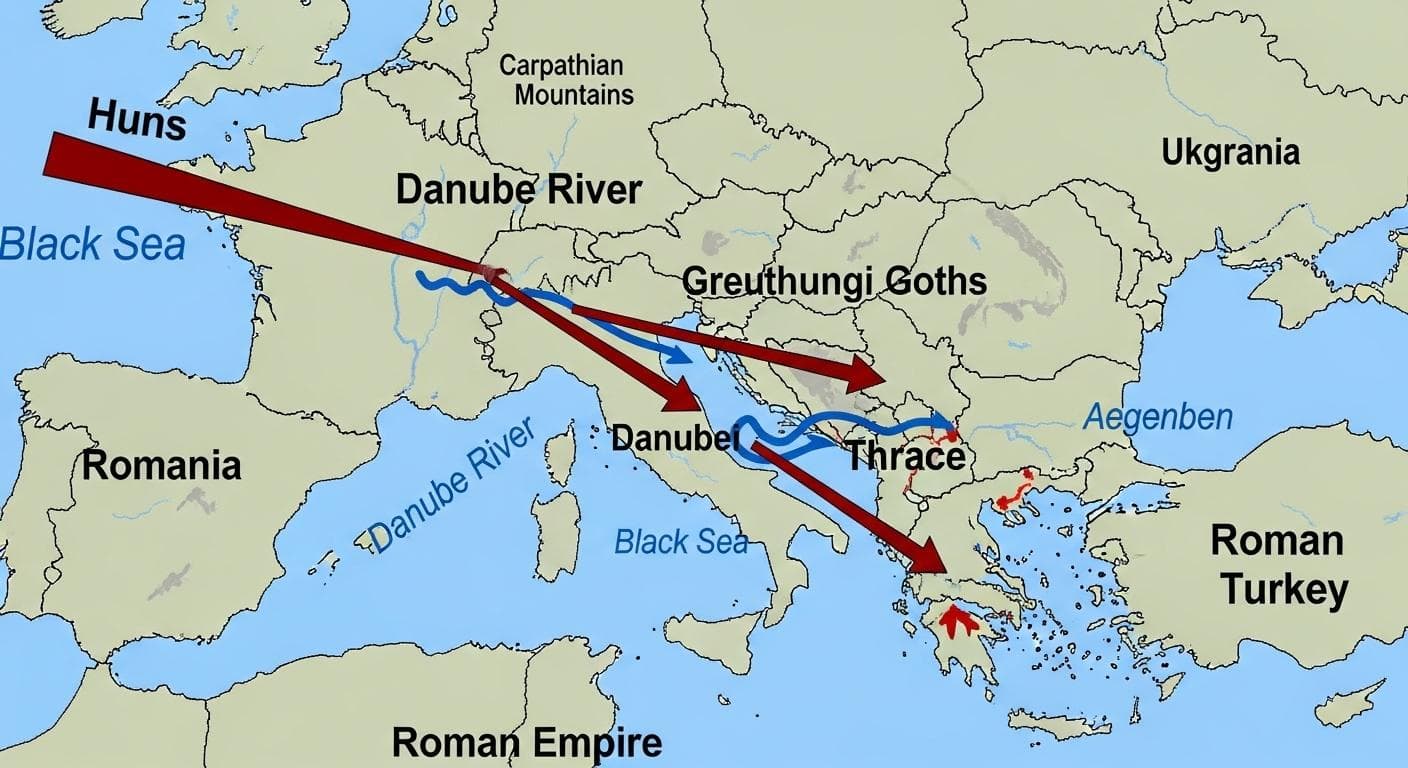
Far to the east, on the vast Eurasian steppe, a nomadic confederation of fearsome horse warriors was on the move: the Huns. Their westward expansion was a force of nature, displacing everything in their path. For the Gothic peoples living north of the Danube River, the Huns represented an existential threat.
Who Were the Goths?
The Goths were not a single, monolithic horde. They were a collection of Germanic tribes, primarily the Thervingi and the Greuthungi (who would later form the core of the Visigoths and Ostrogoths, respectively). They had a complex relationship with Rome, sometimes trading, sometimes raiding, and even serving as mercenaries in Roman armies. They were a formidable people, but they were no match for the Hunnic tide.
A Refugee Crisis on the Danube: A Plea for 'Receptio'
In the autumn of 376 AD, tens of thousands of terrified Goths, led by chieftains like Fritigern, arrived at the Danube, the heavily fortified northern border of the Eastern Roman Empire. They did not come as invaders. They came as refugees, begging for receptio-official permission to cross into the empire, settle on Roman lands, and serve in the army in exchange for protection. For Emperor Valens, ruling from Antioch, this seemed like an opportunity. Here was a massive source of potential soldiers and farmers to fill his depleted ranks and work abandoned lands. He agreed. It was a decision that would seal his fate and that of the empire. The differing fates and political structures of the Eastern and Western halves of the empire are further explored in The Great Division: Why the Roman Empire Split Into East and West.
The First Fatal Flaw Exposed: Systemic Corruption
The plan was sound in theory. In practice, it was a disaster, revealing the true depth of Roman administrative decay.
From Sanctuary to Starvation: How Roman Officials Exploited the Goths
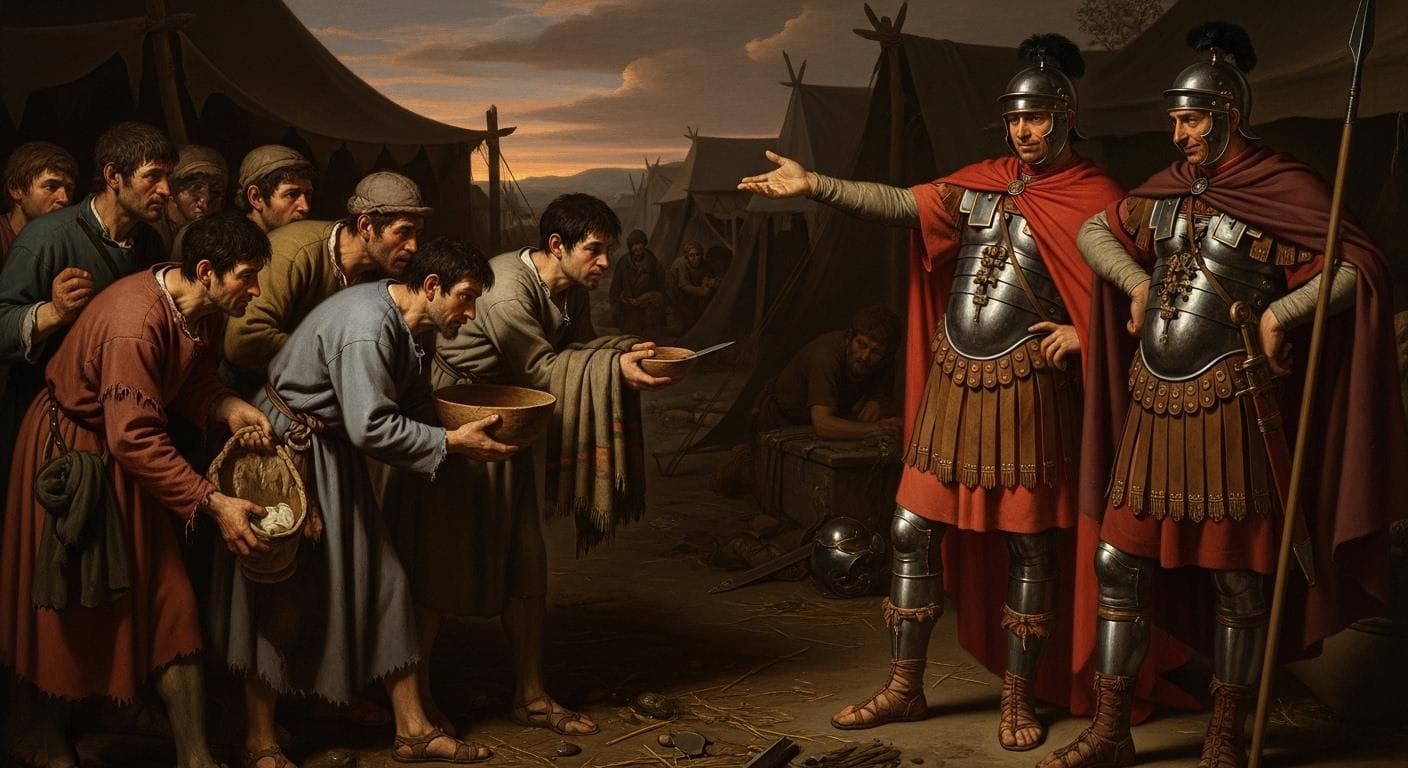
Emperor Valens entrusted the resettlement to two local commanders, Lupicinus and Maximus. Seeing not a strategic asset but an opportunity for personal profit, they turned the humanitarian crisis into an extortion racket. The Roman historian Ammianus Marcellinus, writing just a few years after the event, described the scene with horror:
In the midst of these important transactions, that terrible report, the cause of ruin to the Roman state, suddenly arose, that the race of the Goths, driven from their former habitations... were wandering in great troops on the banks of the Danube... But the corrupt avarice of the generals was the cause of all our disasters.
Lupicinus and Maximus deliberately held back the promised food supplies, forcing the starving Goths to trade everything they owned for scraps. Ammianus reports with disgust that the Romans forced the Goths to trade their children into slavery in exchange for dogs to eat. This wasn't just cruel; it was strategically idiocy. They were systematically turning a potential ally into a desperate and enraged enemy, right inside the empire's borders.
The Turning Point: When Desperation Became Rebellion
The breaking point came when Lupicinus, in a brazen act of treachery, invited the Gothic leaders to a banquet with the intention of assassinating them. Fritigern and the other leaders escaped, and the Goths, who had endured starvation and humiliation, finally erupted in open rebellion. The refugee crisis had become a full-blown war, sparked entirely by Roman corruption and incompetence.
The Second Fatal Flaw Exposed: Military Decay
The Roman military machine was not what it had been. The army had been reformed into two primary types of units: the limitanei, lower-quality garrison troops stationed on the frontiers, and the comitatenses, elite, mobile field armies that served as the emperor's strategic reserve. This system relied on the field armies being able to quickly move and crush any major threat that broke through the porous borders. When Valens decided to crush the Goths, he brought the main Eastern field army with him, supremely confident in its abilities. For a deeper look at these issues, see Analyzing the Collapse: Key Factors in Rome's Military and Political Decline.
The Battle of Adrianople (378 AD): The Day the Legions Broke
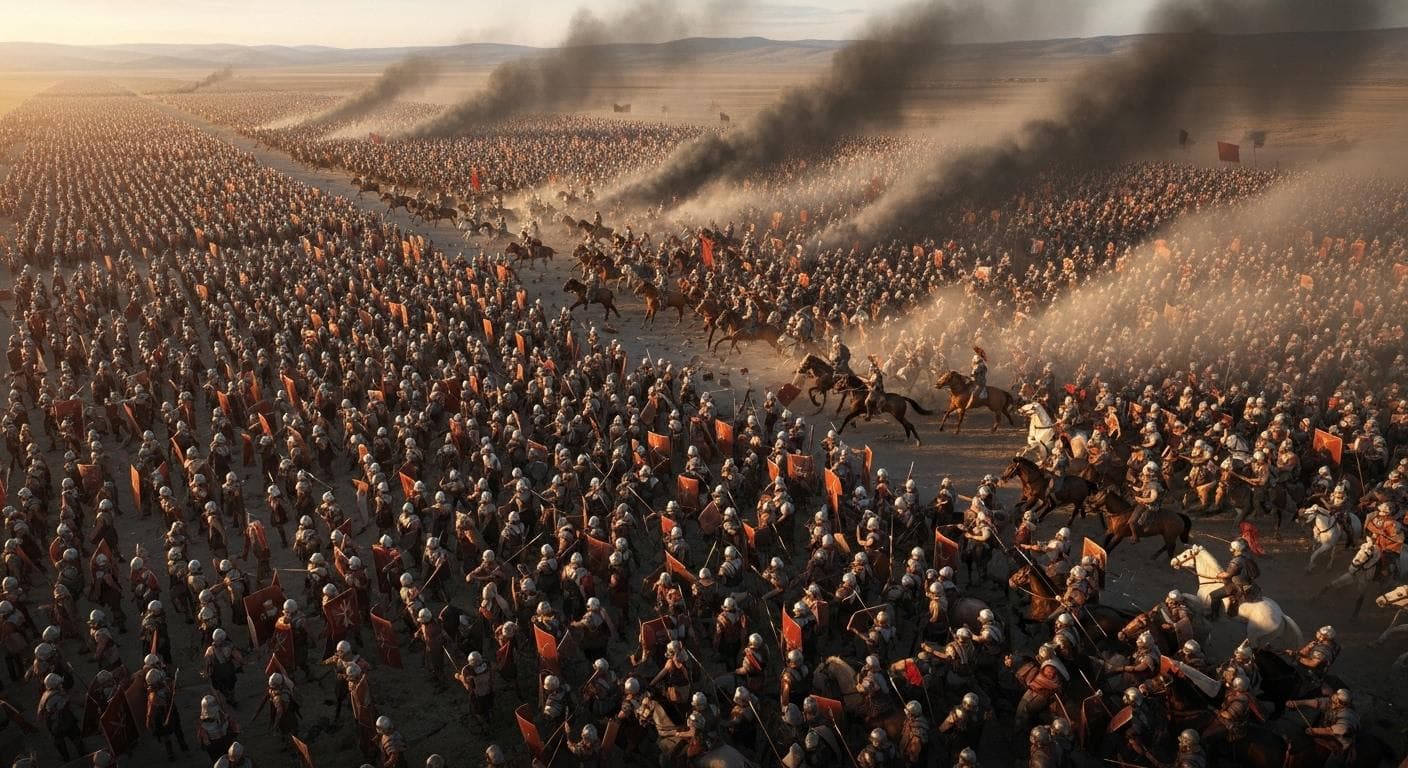
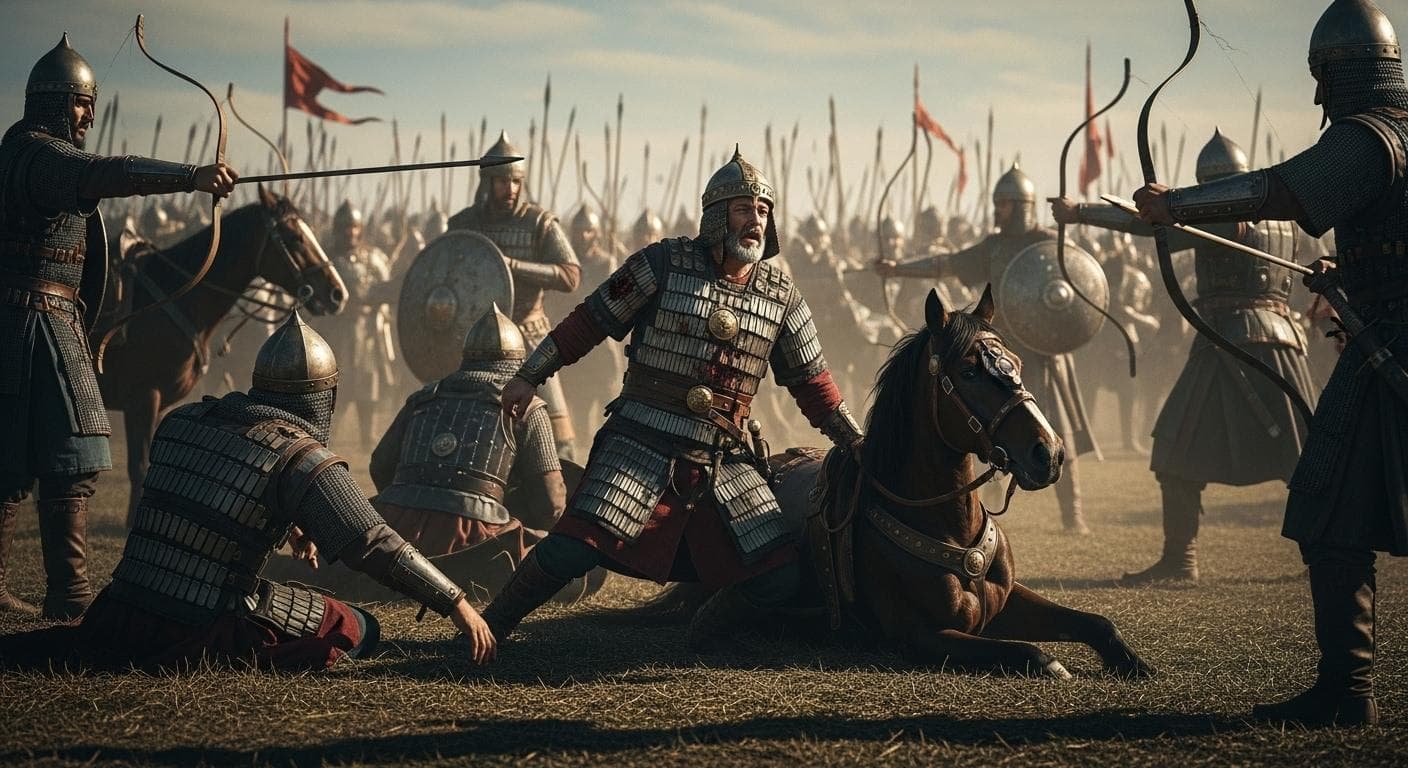
On August 9, 378, near the city of Adrianople (modern Edirne, Turkey), Valens, eager for personal glory and refusing to wait for reinforcements from the Western Emperor Gratian, launched a hasty attack on the Gothic encampment. The battle was a catastrophe for Rome on a scale not seen since Hannibal crushed the legions at Cannae six centuries earlier.
Why It Happened: How Gothic Cavalry Shattered the Myth of Roman Invincibility
The Roman infantry, exhausted from a long march under the hot summer sun, were bogged down in a frontal assault. At the critical moment, the powerful Gothic heavy cavalry, which had been away foraging, returned and smashed into the Roman flank. The Roman lines buckled, then broke completely. What followed was not a battle, but a slaughter. The myth of the invincible Roman infantry, the bedrock of its military dominance for half a millennium, was shattered in a single afternoon.
The Unthinkable: The Death of an Emperor on the Battlefield
Amidst the carnage, Emperor Valens was wounded and either killed on the field or burned alive in a farmhouse where he had taken refuge. For the first time in centuries, a Roman emperor had been killed in battle by a foreign enemy. The psychological shock was immense. The empire had not only lost an army-it had lost its aura of destiny. Two-thirds of the Eastern field army, tens of thousands of its best soldiers, lay dead. The empire's primary strategic reserve in the east was gone.
The Third Fatal Flaw Exposed: Political Paralysis
The aftermath of Adrianople was chaos. With the main army destroyed, there was nothing to stop the victorious Goths. They were a victorious, independent, and hostile military force operating with impunity deep within Roman territory. They pillaged the Balkans for years, a mobile wound that the empire could not heal.
The "Solution" of Theodosius I: Creating a Rogue State Within the State (Foederati)
The new Eastern Emperor, Theodosius I, realizing he could not defeat the Goths militarily, negotiated a treaty in 382 AD. This was not a traditional Roman settlement. The Goths were not disarmed or dispersed. They were settled as a single, autonomous nation within the empire's borders, allowed to live under their own laws and leaders. In exchange, they were obligated to fight for Rome as allied troops, known as foederati.
This was a fatal compromise. Theodosius had papered over the crisis by essentially sanctioning a barbarian state inside his own. He solved the immediate problem by creating a much larger, long-term one: a powerful, cohesive group of non-Romans who had no institutional loyalty to the empire they now served.
The Domino Effect: Alaric and the Sack of Rome (410 AD)
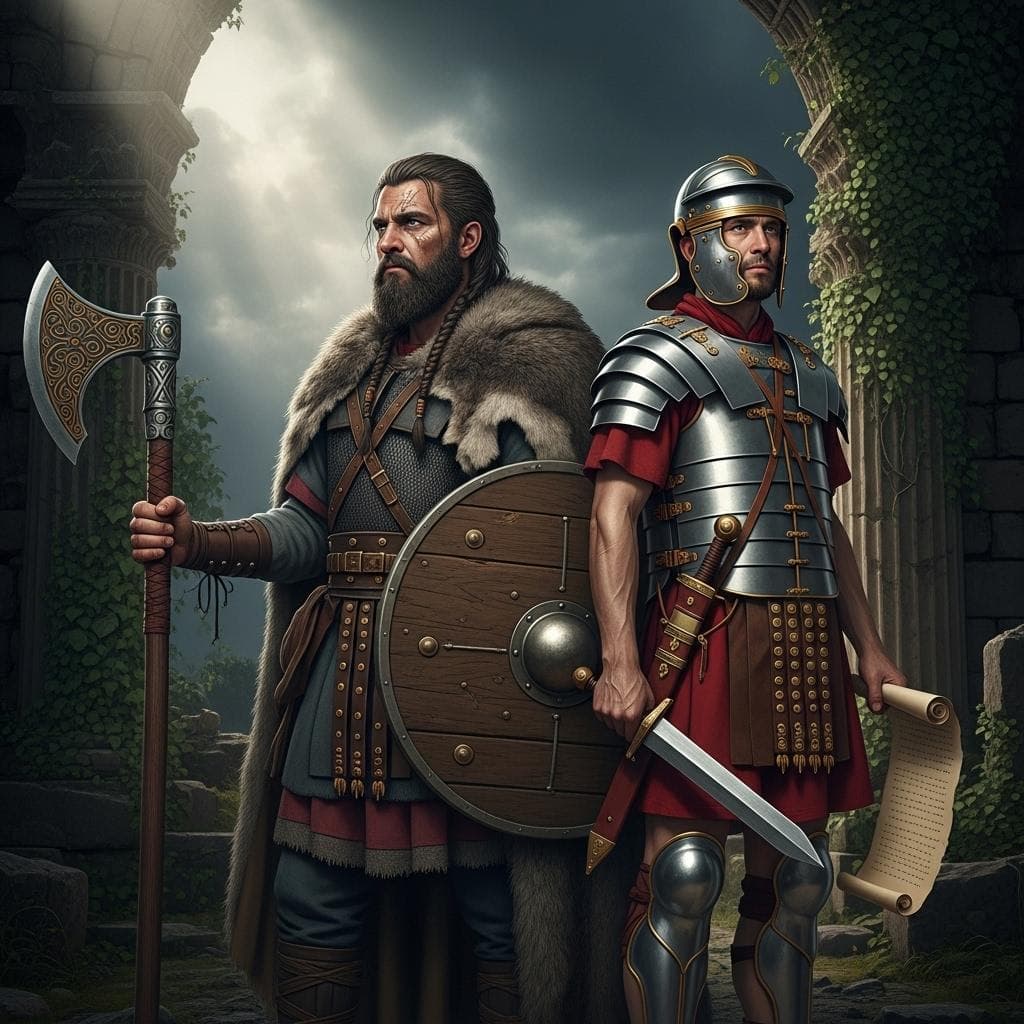
This new policy of relying on foederati set the stage for the final act. One of the Goths who fought for Theodosius was a young noble named Alaric. He learned Roman tactics, understood Roman weaknesses, and felt the sting of Roman prejudice and broken promises.
From Unpaid Ally to Avenging Enemy
After Theodosius's death, Alaric and his Goths were repeatedly denied the pay, positions, and respect they believed they had earned. Feeling betrayed, Alaric turned his foederati army against the empire that had created it. For years, he rampaged through Greece and Italy, a direct product of Rome's failed policies.
The Psychological Blow That Echoed Across the World
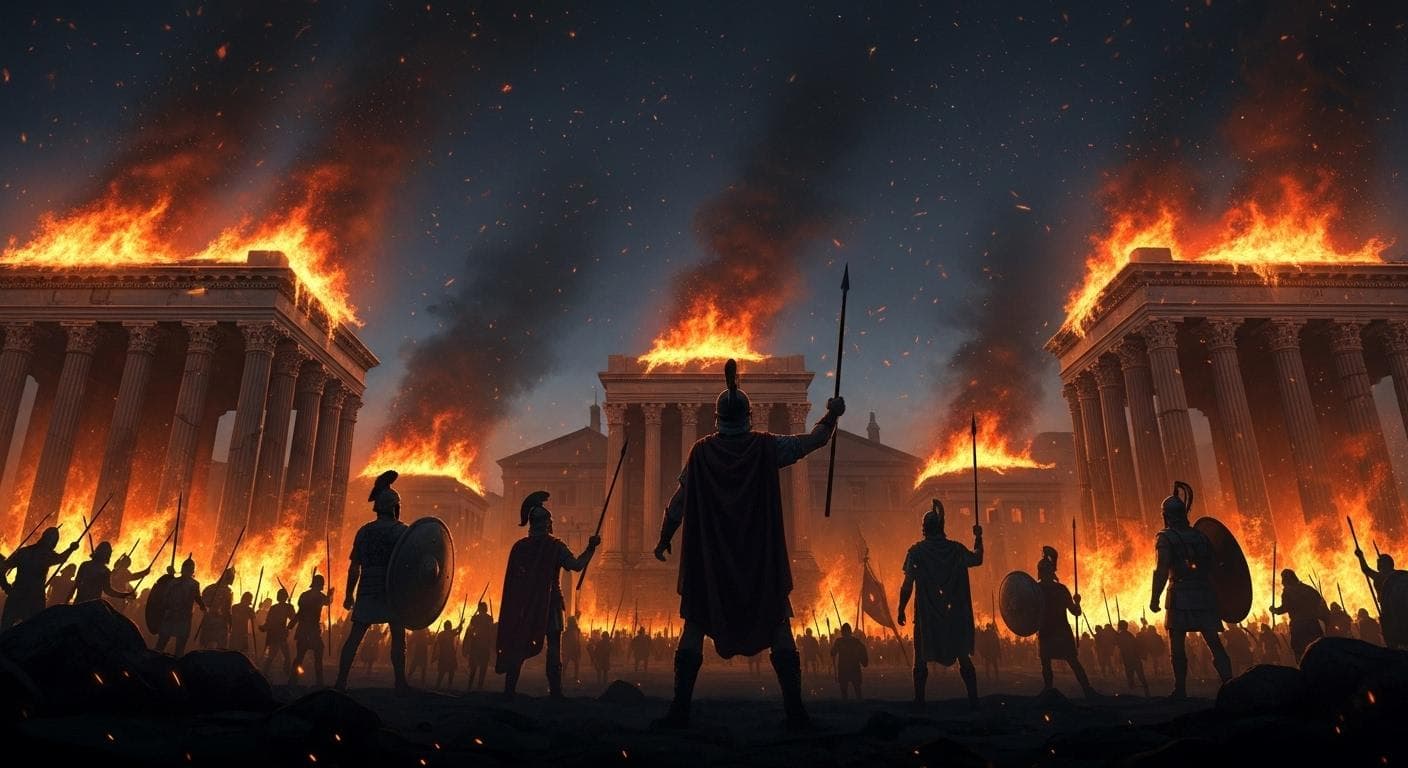
In 410 AD, after a series of political blunders by the Western Roman court in Ravenna, Alaric's Visigoths did the unimaginable: they entered and sacked the city of Rome. While the city was no longer the political capital, it was the eternal heart of the empire. The news sent shockwaves through the civilized world. If Rome itself could fall, what was safe? The event signaled to all other barbarian groups that the Western Empire was a hollow shell, its lands ripe for the taking. The Goths had provided the blueprint, and over the next 60 years, the Vandals, Franks, and others would follow their lead, carving out kingdoms until there was no empire left to save. The profound impact and continuation of Roman ideas after this collapse is explored in After the Fall: The Enduring Legacy of Rome and the Catholic Church.
Conclusion: The Autopsy of an Empire
The fall of Rome was a complex process with many contributing factors, but the Gothic migration crisis serves as the perfect microcosm of the entire collapse. It demonstrates, with brutal clarity, how a manageable external pressure can shatter a system already weakened from within.
The Goths weren't an unstoppable force of nature that brought down a healthy empire. They were desperate refugees who were mismanaged by corrupt officials, radicalized into enemies, and then, after defeating a decaying army, were incorporated into the state in a way that guaranteed future conflict. Each step of the way, Rome's leadership made the worst possible choice, guided by greed, arrogance, and a fatal inability to adapt to a changing world. The Goths were not the cause of death; they were merely the ones who signed the death certificate, a pivotal moment in The Ultimate Guide to the Fall of the Roman Empire.
What do you believe was the single most critical failure in Rome's handling of the Gothic crisis? Was it the initial corruption at the Danube, Valens's hubris at Adrianople, or Theodosius's foederati treaty? Share your analysis in the comments below.

Comments
We load comments on demand to keep the page fast.