The split of the Roman Empire into East and West is often viewed as a sudden, cataclysmic event-a line drawn in the sand in 395 CE from which there was no return. But the reality is far more complex and fascinating. This great fracture wasn't the result of a single decision or a lost war; it was the culmination of a century of strategic adaptation, economic realignment, and deepening cultural divergence. To truly understand why the world's greatest empire broke in two, we must see it not as a monolithic state that failed, but as a sprawling global enterprise that became too big to manage under a single command structure.
An Empire Too Big to Govern: The Cracks Begin to Show
By the third century CE, the Roman Empire was a victim of its own staggering success. Its borders stretched from the cold mists of Britain to the desert sands of Mesopotamia, encompassing dozens of cultures and millions of people. This vast territory presented an unprecedented logistical and administrative nightmare. News, troop movements, and tax revenues traveled at the speed of a horse, meaning a crisis on the Persian frontier might not be known in Rome for weeks, by which time it could have escalated into a full-blown disaster.
The Crisis of the Third Century: A Realm on the Brink of Collapse
The period from 235 to 284 CE was a perfect storm of existential threats that nearly ended the Roman experiment. Known as the Crisis of the Third Century, it was a 50-year-long nightmare of:
- Endless Civil War: More than 26 men were officially proclaimed emperor during this period, most of whom were generals who ruled for only a few months before being assassinated by a rival or their own troops. This constant turmoil paralyzed the central government.
- Constant Invasions: With the legions busy fighting each other for political power, the empire's long frontiers became dangerously porous. Gothic tribes crossed the Danube, the Alamanni pushed into Gaul and Italy, and the powerful Sassanian Empire in Persia applied relentless pressure in the East.
- Economic Collapse: To pay the soldiers they desperately needed, emperors massively debased the currency, leading to hyperinflation that crippled the economy. Trade networks broke down, and a plague swept through the empire, devastating the population and the tax base.
The empire was literally tearing itself apart. Breakaway states, like the Gallic Empire in the West and the Palmyrene Empire in the East, formed as local leaders decided they could do a better job of defending themselves than the chaotic government in Rome. The Roman world was on the verge of total collapse.
The First Cut: Diocletian's Radical Solution - The Tetrarchy (286 CE)
Into this chaos stepped a brilliant general and administrator named Diocletian. He recognized the fundamental problem: the empire was simply too large and beset by too many simultaneous crises for one man to handle. His solution was radical and unprecedented: the Tetrarchy, or "rule of four."
What Was the "Rule of Four"?
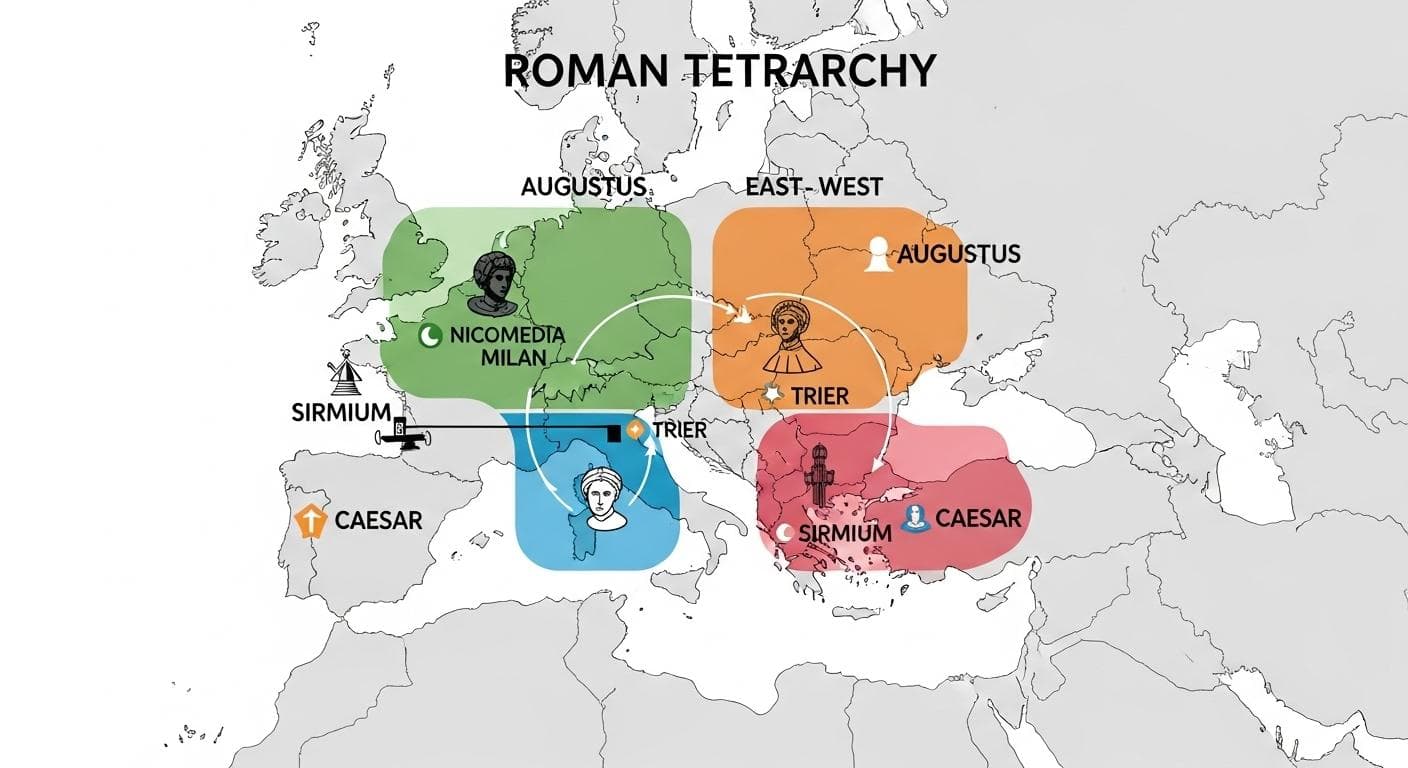
In 286 CE, Diocletian formally divided the empire's administration. He took the wealthier, more strategic East for himself and appointed a trusted colleague, Maximian, to rule the West. Both were given the senior title of Augustus. Then, in 293 CE, he expanded the system by appointing two junior emperors, Galerius and Constantius, as Caesars. This created four imperial courts, each located not in Rome, but in a strategic city closer to a troubled frontier: Diocletian in Nicomedia (Turkey), Maximian in Milan (Italy), Galerius in Sirmium (Serbia), and Constantius in Trier (Germany).
Why This Wasn't Just About Size, But Survival
The Tetrarchy was never intended to be a permanent split. It was a brilliant administrative solution designed for pure survival. By having an emperor near every major flashpoint-the Rhine, the Danube, the Persian frontier-the empire could respond to threats with unprecedented speed and efficiency. The system stabilized the military, reformed the currency, and brought an end to the decades of bloody chaos. Diocletian had saved the Roman Empire, but in doing so, he had proven that it could be governed effectively as two separate entities. The seed of division had been planted.
A New Center of Gravity: How Constantine's Constantinople Changed Everything (330 CE)
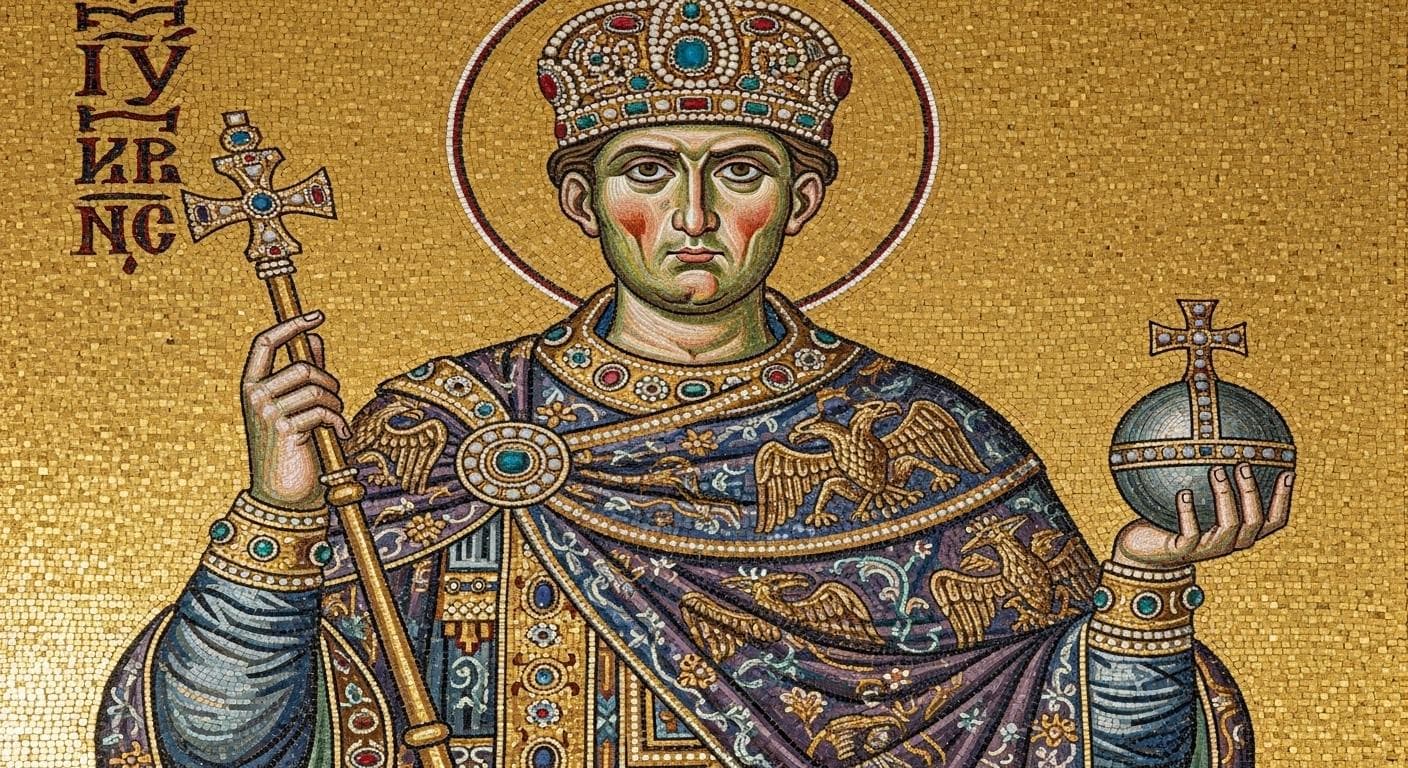
The Tetrarchy eventually collapsed into another round of civil wars after Diocletian's abdication. From the ashes rose another visionary leader: Constantine the Great. After reuniting the empire under his sole rule, he made a decision that would irrevocably shift its destiny. On May 11, 330 CE, he formally dedicated a new capital on the site of the ancient Greek city of Byzantium, naming it Constantinople-"the City of Constantine."
Why Move the Capital from Rome?
This choice was a masterstroke of geopolitical strategy. The city of Rome was an ancient symbol rich with tradition, but it was strategically irrelevant. It was far from the empire's most critical frontiers and its wealthiest provinces. Constantinople, on the other hand, was perfect:
- Immensely Defensible: Located on a peninsula, it was protected by water on three sides and could be fortified with massive, impenetrable walls.
- Unrivaled Strategic Location: It commanded the Bosphorus Strait, the gateway between Europe and Asia, and the crucial trade routes connecting the Black Sea to the Mediterranean.
- Proximity to Power: It was close to the dangerous Danube frontier and the wealthy eastern provinces of Egypt, Syria, and Anatolia, which were the empire's true economic engine.
The Economic and Cultural Rise of the Greek East
The founding of "New Rome" created a new center of gravity for the entire Roman world. Wealth, talent, and power flowed eastward. The Senate of Constantinople soon rivaled the one in Rome. While the West became increasingly rural, de-urbanized, and economically fragile, the East thrived. This act didn't just move the capital; it fundamentally accelerated a cultural and economic divergence that was already underway, creating two distinct Roman worlds under a single imperial banner.
The Point of No Return: The Final Division Under Theodosius's Sons (395 CE)
For most of the 4th century, the empire cycled between periods of single rule and co-rule between East and West. The idea of a single, unified state remained, even if it was often governed by multiple emperors.
Emperor Theodosius I: The Last Ruler of a United Roman Empire
Emperor Theodosius I would be the last man to rule over this unified, if often co-managed, empire. A capable military leader, he dealt with numerous threats, including a major Gothic crisis, and cemented Christianity as the state religion. But upon his death in 395 CE, he followed what was now becoming standard practice: he bequeathed the empire to his two sons to rule jointly.
Arcadius in the East, Honorius in the West: A Permanent Break
His elder son, Arcadius, took control of the Eastern Roman Empire from the secure and wealthy capital of Constantinople. His younger son, Honorius, ruled the Western Roman Empire, not from Rome, but first from Milan and later, from 401 CE, from the easily defended coastal marsh city of Ravenna. In theory, this was just another co-rulership. In practice, it was the final, permanent split. The two brothers were weak and easily manipulated by their courts, which were often hostile to one another. They never worked together, and the two halves of the empire began to operate as separate, and sometimes rival, states.
Two Empires, Two Fates: Why the Split Became Permanent
Unlike previous divisions, the split of 395 CE stuck. The two halves would never again come under the rule of a single emperor. The underlying administrative convenience had been solidified by deep-seated cultural and economic realities that could no longer be ignored.

Growing Apart: Language, Culture, and Religion
The West was predominantly Latin-speaking, while the administrative and intellectual language of the East was, and had always been, Greek. Over time, these linguistic differences deepened into a cultural chasm. Religious disputes, particularly over the nature of Christ, further drove the two halves apart, with the Bishop of Rome (the Pope) and the Patriarch of Constantinople emerging as rival centers of Christian authority.
Economic Divergence: The Wealthy East vs. the Struggling West
This was perhaps the most crucial factor. The Eastern Empire contained the wealthiest provinces, controlled vital trade routes, had a larger and more urbanized population, and maintained a more professional bureaucracy and a robust tax base. It could afford to pay its armies and buy off its enemies. The West, in contrast, was economically anemic. Its economy was based on large, isolated agricultural estates, its tax base was shrinking, and it relied increasingly on recruiting barbarian mercenaries who had little loyalty to Rome. The East was a viable, self-sustaining state; the West was a house of cards waiting for a gust of wind.

Conclusion: Not a Sudden Split, But a Slow Separation
The division of the Roman Empire was not an act of malice or a singular failure. It was a pragmatic, century-long adaptation to the overwhelming pressures of scale. Diocletian's administrative cut was a life-saving surgery. Constantine's new capital shifted the empire's heart to a more sustainable location. The final split under Theodosius's sons was simply the formal recognition of a reality that had been developing for generations: the Roman world had become two distinct civilizations operating under a shared, but increasingly frayed, legacy.
The wealthy, urbanized, and strategically sound East would survive and morph into the Byzantine Empire, lasting for another thousand years. The impoverished, overstretched, and militarily weakened West would crumble less than a century later, in 476 CE. The great fracture was not the cause of the fall of Rome, but rather the mechanism by which one half of the empire survived while the other was left to its fate.
What do you think was the single most important factor in the permanent split: Diocletian's administrative division, Constantine's new capital, or the underlying economic differences between East and West? Share your thoughts in the comments below.

Comments
We load comments on demand to keep the page fast.